

In the fast-paced development of Middle Eastern industrial zones and commercial mega-projects, electrical infrastructure is often subjected to intense budget and schedule pressures. However, compromising on the heart of your power distribution network is a gamble that inevitably ends in disaster. Partnering with a specialized electrical engineering consulting firm in Dubai in the earliest stages of a project is critical to establishing a rigorous baseline for equipment specifications. Without this expertise, the electrical under-specification risks are immense.
Switchgear acts as the primary defense mechanism for your entire facility, tasked with safely distributing massive amounts of energy and containing explosive faults. The harsh GCC environment, characterized by relentless ambient heat, high humidity, and pervasive fine dust, dramatically amplifies standard electrical and mechanical stresses. A switchboard that performs flawlessly in a temperate European climate can suffer catastrophic thermal failure in a Dubai summer if not appropriately derated. Proper switchgear rating validation is not merely a bureaucratic checklist; it is an uncompromising engineering defense against lethal arc flashes, multimillion-dirham equipment losses, and crippling operational downtime.
Understanding Nominal vs. Operational Voltage Ratings (Ur, Ud, Up)
Validating a switchgear panel begins with ensuring its insulation can withstand the electrical pressures it will face, both normally and during extreme grid events. This goes far beyond the simple “operating voltage.”
Engineers must rigorously validate three distinct switchgear voltage ratings:
- Rated Voltage ($U_r$): The maximum root-mean-square (RMS) voltage the equipment can handle continuously (e.g., 12kV for an 11kV network).
- Power-Frequency Withstand Voltage ($U_d$): The equipment’s ability to withstand a significant overvoltage (e.g., 28kV) for a short duration (typically 1 minute) to prove basic insulation integrity.
- Lightning Impulse Withstand Voltage ($U_p$): This is critical in the GCC. Also known as the Basic Insulation Level (BIL), it measures the panel’s ability to survive a massive, microsecond voltage spike (e.g., 75kV or 95kV).
While lightning strikes are relatively infrequent in the desert, massive industrial plants frequently experience severe “switching transients”, high-voltage spikes caused by the sudden operation of large motors or capacitor banks. Therefore, a high lightning impulse withstand rating is mandatory to prevent the insulation from breaking down over time.
Validating Current Ratings and Thermal Capacity
The most common and dangerous area of under-specification in the Gulf relates to current ratings and the system’s ability to manage heat.
Continuous current ($I_r$) indicates the load the switchgear can carry constantly, while short circuit withstand current ($I_{sc}$) dictates the massive fault current it can survive for a brief duration (e.g., 3 seconds) without melting or physically deforming due to electromagnetic forces.
However, the “nameplate” rating on a brochure is often deceptive. A manufacturer might rate a breaker at 2000A based on an ambient temperature of 35°C. In the GCC, electrical room temperatures, especially if the HVAC fails during summer, can easily exceed 50°C. At this temperature, the copper busbars and breaker contacts cannot dissipate heat effectively. Rigorous validation of the switchgear thermal capacity requires obtaining certified manufacturer derating tables. A 2000A breaker at 35°C might only safely carry 1600A at 55°C. Failing to account for this environmental derating leads directly to overheating, accelerated insulation aging, and eventual fire.
The Crucial Role of Internal Arc Classification (IAC)
When a short circuit jumps across phases inside a switchboard, it creates an arc flash, a violent explosion of plasma that generates temperatures hotter than the surface of the sun, accompanied by a lethal pressure wave and toxic gases.
To protect personnel who might be operating or walking past the equipment, internal arc classification (IAC) is a non-negotiable life-safety feature. The internationally recognized IEC 62271-200 switchgear standard classifies how well a panel can contain this explosion.
- Accessibility: The rating (e.g., IAC AFLR) indicates that the panel protects personnel from the Front (F), Lateral sides (L), and Rear (R).
- Duration: The rating specifies how long the panel can contain the fault (e.g., 31.5kA for 1 second) without doors blowing off or burn-throughs occurring.
Validating this rating ensures that the switchgear is equipped with proper pressure relief flaps and exhaust plenums that safely direct the explosive gases up and out of the electrical room, rather than out toward the operator.

Ingress Protection (IP) Requirements for Desert Environments
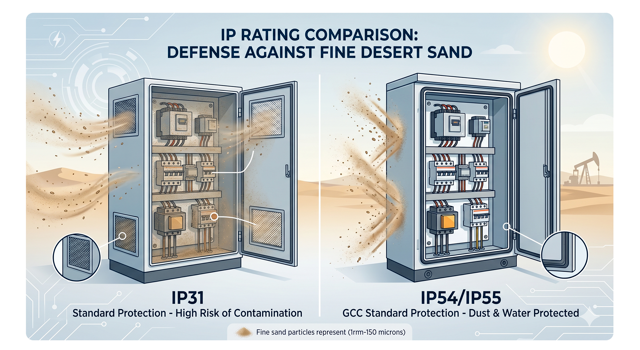
The relentless, fine desert dust of the Middle East acts as both a thermal insulator and, when mixed with coastal humidity, a corrosive electrical conductor. Protecting the internal components of the switchgear from this threat is paramount.
While European indoor standards might comfortably specify IP31 or IP41, realistic GCC demands dictate a much higher switchgear IP rating. For standard indoor electrical rooms in the Gulf, validating an IP54 or IP55 rating is heavily recommended. This ensures the desert environment electrical panels are protected against the ingress of dust that can interfere with the delicate mechanical linkages of the circuit breakers and coat the busbars, causing them to overheat. Outdoor panels or those in heavy industrial areas may require IP65 ratings and specialized double-skin, sun-shielded enclosures.
Protection Coordination and Relay Integration
A switchgear panel is only as safe as the “brain” commanding it to open during a fault. This brain consists of advanced, microprocessor-based protection relays.
In the GCC, utilities like DEWA and SEC have strict mandates regarding the specific makes, models, and functionalities of these relays at the grid connection point. The switchgear must be physically designed to accommodate these exact devices. Furthermore, the accuracy of these relays relies entirely on the analog signals they receive from the Current Transformers (CTs) and Potential Transformers (PTs) inside the panel.
Ensuring that the CTs will not “saturate” (become magnetically overloaded and stop sending accurate data) during a massive fault requires precision. Validating this integration is the direct result of comprehensive power system analysis and design. The engineering study dictates the exact burden and accuracy class required for the current transformer sizing, ensuring flawless switchgear protection coordination that isolates faults instantly without causing nuisance trips.
Mechanical Endurance and Switching Cycles
Electrical specifications often overlook the physical, moving parts of the switchgear. However, in heavy industrial plants with frequent motor starts, capacitor bank switching, or automated load shedding, the mechanical resilience of the breaker is tested daily.
The IEC standards classify circuit breaker mechanical endurance into different categories:
- M1 Class: Standard endurance, typically rated for 2,000 operating cycles. Suitable for standard distribution where breakers are rarely opened or closed.
- M2 Class: Extended endurance, rated for 10,000 operating cycles.
Validating an M2 rating is critical for an industrial switchgear lifecycle where the breakers act almost as contactors, switching loads multiple times a day. Specifying an M1 breaker for a high-frequency switching application will lead to premature mechanical linkage failure, spring fatigue, and a breaker that refuses to close when the plant needs it most.
Factory Acceptance Testing (FAT) Protocols
The ultimate validation of all specifications occurs before the equipment ever leaves the manufacturer’s facility. The Factory Acceptance Test is the project manager’s final safety net.
A rigorous switchgear FAT procedure is not a mere visual inspection; it is a physical and electrical interrogation of the panel. Key tests that must be witnessed include:
- Dielectric Testing: Applying high voltage to verify the $U_d$ insulation rating.
- Mechanical Operations: Proving the breakers rack in and out smoothly and operate reliably.
- Primary Injection Testing: Injecting actual high current to prove the CTs and relays trip the breaker exactly as designed in the coordination study.
- Temperature Rise Test Verification: Reviewing the type test certificates to ensure the panel can actually carry its rated current without exceeding maximum temperature limits.
Strict electrical panel factory testing guarantees that under-specified or poorly assembled equipment is rejected at the factory, preventing crippling delays during site commissioning.
Procurement Strategies for Specialized Switchgear
The rigorous specifications required for a climate-adapted, highly rated medium voltage switchboard in the GCC inherently conflict with fast-track construction schedules. Highly specified, IAC-classified switchgear is not kept on a warehouse shelf; it is custom-manufactured.
Lead times for these critical assets often extend from 6 to 12 months. When schedules compress, there is a dangerous temptation for contractors to request deviations, offering lower-rated, “off-the-shelf” alternatives to save time.
This is where strategic Electrical Plant Procurement becomes essential. By finalizing the technical specifications and placing orders in the earliest phases of the project lifecycle, experienced procurement teams secure the manufacturing slots for the correct equipment. This proactive switchgear procurement UAE strategy ensures the facility receives the robust medium voltage panel sourcing it requires, without sacrificing safety for the sake of the schedule.
Frequently Asked Questions (FAQ)
1. What is the difference between a Type Test and a Routine Test for switchgear?
Type tests are rigorous, one-time tests performed on a prototype panel by an independent laboratory (like KEMA or ASTA) to validate the overall engineering design, including short-circuit withstand capabilities and internal arc containment. Routine tests (often witnessed during a FAT) are basic functional and dielectric tests performed on every single unit rolling off the assembly line to ensure manufacturing quality.
2. Can we use standard IP31 rated switchboards in an air-conditioned electrical room in the GCC?
While technically permissible in perfectly sealed, climate-controlled environments, it is highly risky. In the GCC, fine desert dust inevitably enters electrical rooms through doors, ventilation ducts, or during maintenance. Specifying IP54 or IP55 provides a crucial layer of defense against dust ingress that can otherwise jam mechanical breakers or cause tracking faults on the busbars.
3. What does Internal Arc Classification (IAC) AFLR mean?
IAC guarantees the switchgear can safely contain an internal explosion (arc flash) without bursting open and injuring personnel. “AFLR” indicates that the panel provides protection to operators standing at the Front (F), Lateral sides (L), and Rear (R) of the equipment, safely venting the explosive gases and pressure away from the room’s occupants.
4. Why is the Lightning Impulse Withstand (BIL) rating important if thunderstorms are rare in the desert?
While direct lightning strikes are infrequent, massive industrial facilities and high-rises frequently experience “switching transients.” These are severe, microsecond high-voltage spikes caused by the sudden switching of large motors, capacitor banks, or utility grid operations. A high BIL rating ensures the switchgear’s insulation can survive these internal spikes without breaking down over time.
5. How severely does the GCC summer heat impact switchgear current ratings?
Significantly. A circuit breaker rated for 2,000 Amps at an international standard of 35°C might only safely carry 1,600 Amps when operating in an unventilated electrical room that reaches 55°C. If this “thermal derating” factor is not calculated and applied during the initial design phase, the switchgear will overheat and trip the main power under normal facility load.
Conclusion & Next Steps: Engineering for Reliability
Validating switchgear ratings is not an area for compromise. It is a fundamental engineering defense mechanism that protects human lives, secures multimillion-dirham capital investments, and guarantees the operational uptime of critical facilities in the harshest of environments. From navigating high-temperature derating and IP54 dust protection to enforcing strict FAT protocols, every specification must be scrutinized and mathematically proven.
Accepting a generic datasheet without digging into the specific operational realities of the GCC climate is a direct path to under-specification and eventual failure.
Does your switchgear specification actually match your project’s risk profile?
Do not wait for a catastrophic failure or a failed utility inspection to find out. Partner with a premier electrical engineering consulting firm to safeguard your infrastructure. Elecwatts specializes in rigorous switchgear specification audit and design services, ensuring your assets are perfectly tailored to the demanding realities of the Gulf.
Contact Elecwatts today to connect with our expert GCC electrical consultants and secure the long-term reliability of your power distribution network.