

Introduction: The Safety vs. Cost Fallacy
Walk onto any major construction site in the GCC, and you’ll hear a familiar refrain: “Just size it up to be safe.” It’s a well-intentioned impulse. In a region known for its demanding climate and uncompromising safety standards, the instinct to add another layer of “safety factor” feels prudent. A 125% factor on the load. A cable two sizes up. An extra transformer for “future-proofing.”
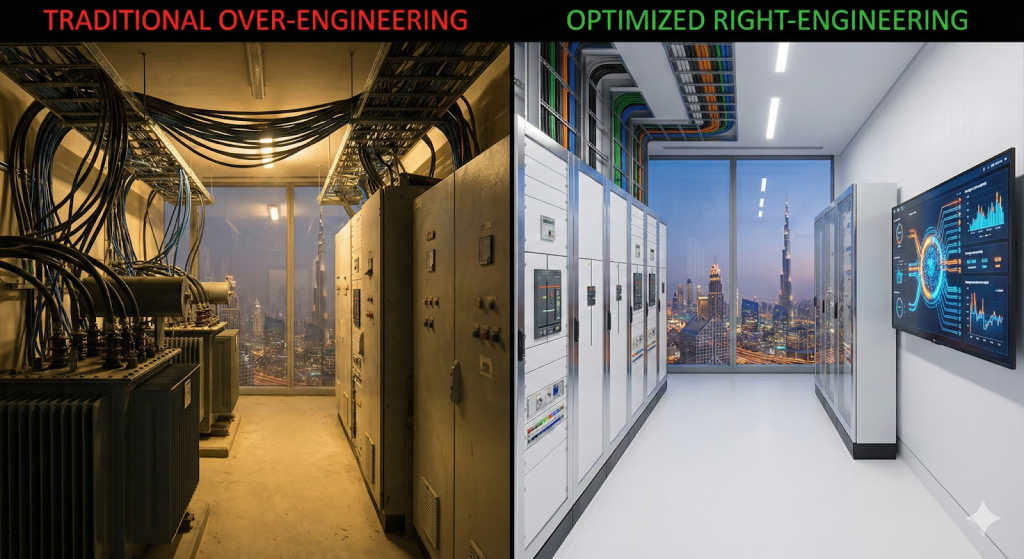
But what if this ingrained habit is silently eroding your project’s financial viability? This practice of arbitrary over-engineering doesn’t just inflate your initial CAPEX; it saddles the asset with a legacy of inefficient OPEX, turning a one-time cost decision into a permanent financial drain.
In today’s competitive GCC market, optimal design isn’t a binary choice between reckless cost-cutting and blanket over-engineering. The winning strategy is right-engineering: a precise, data-driven, and fully compliant approach that delivers safety, reliability, and capital efficiency. It’s the sweet spot where engineering excellence meets financial intelligence.
The Hidden Expenses of Over-Engineering
The impact of an oversized electrical system is rarely confined to a single line item. It creates a cascade of unnecessary costs:
- Direct CAPEX Bloat: The most visible hit. This includes oversized cables, switchgear with higher interrupting ratings than needed, transformers operating at 40% load, and backup generators that will never see their full capacity. You’re paying a premium for capacity that will literally never be used.
- Lifelong OPEX Penalty: This is the silent budget killer. Oversized cables have higher electrical resistance (I²R losses), wasting energy as heat 24/7, 365 days a year. An underloaded transformer operates at a lower efficiency point, increasing no-load losses. Furthermore, all this excess heat then requires more HVAC capacity to remove, compounding your energy costs. You pay for the electricity twice: once to waste it, and again to cool its byproduct.
- Space & Logistics Costs: In dense urban towers or premium industrial plots, space is revenue. Oversized cables demand larger trays and conduits. An oversized switchgear lineup or transformer requires a larger substation footprint. This isn’t just about concrete and steel; it’s about sacrificing leasable, sellable, or productive space for no functional benefit.
The Catastrophic Risks of Under-Engineering (The “Swing Too Far” Warning)
Before you mandate a 20% across-the-board cut, a critical warning: The solution to over-engineering is not under-engineering.
The risks of a system stretched beyond its limits are severe and non-negotiable: overloaded cables leading to insulation failure and fire, violation of utility codes resulting in connection denial, increased arc flash incident energy endangering personnel, and guaranteed operational downtime. This path saves pennies upfront to risk millions in losses, liability, and reputation.
True optimization is not about cutting corners; it’s about removing excess.
The Path to Optimization: It’s in the Analysis
Replacing guesswork and arbitrary factors with engineering precision is how you achieve right-engineering. This requires specific, advanced studies:
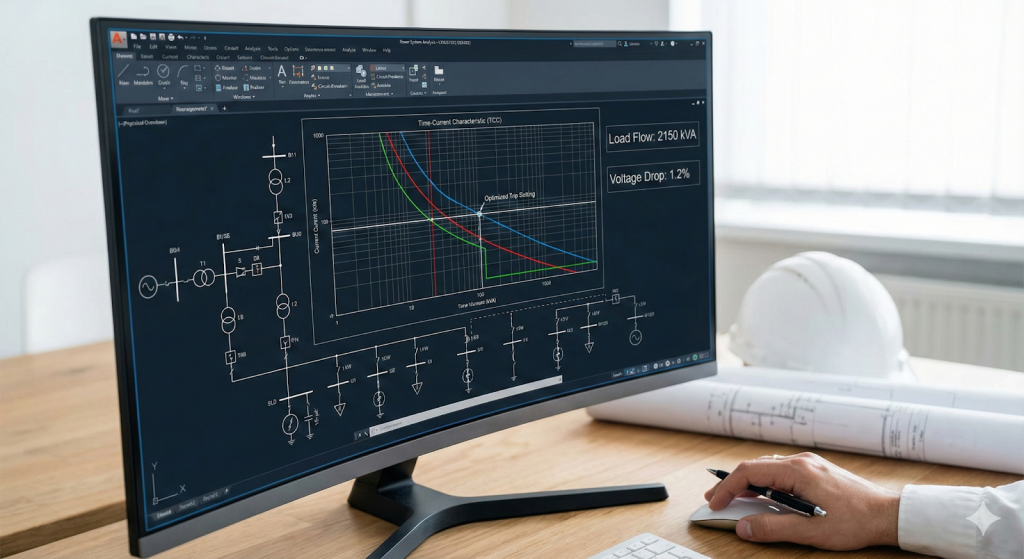
- Accurate Load Flow Analysis: This is the cornerstone. It moves beyond a simple, additive load schedule to model how power actually flows through your system under various real-world operating scenarios. It identifies the true maximum demand on each feeder, transformer, and generator, allowing you to specify equipment based on proven need, not inflated estimates.
- Precision Cable Sizing & Ampacity Studies: Rather than defaulting to the next size up, this study balances safety (thermal rating), performance (voltage drop limits), and the unique GCC ambient conditions (soil thermal resistivity, air temperature) to select the most economical cable that will perform reliably for its lifespan.
- Protection Coordination Study: Optimization isn’t just about the power path; it’s about the protection system. This study ensures protective devices (circuit breakers, fuses) are selected and set to trip only when and where they should. This prevents the costly over-specification of breakers and ensures selective coordination, minimizing downtime during a fault.
Case in Point: Savings Through Precision
Challenge: A developer for a flagship mixed-use tower in Dubai had a preliminary design featuring four 2,500 kVA main transformers. The design was based on a conservative, diversified load sum.
Our Action: ElecWatts performed a dynamic Load Flow Analysis and a detailed Harmonic Analysis, modeling the actual usage profiles of the hotel, offices, and residences. We identified that the true peak concurrent demand, even with diversity, was 18% lower than initially calculated.
Result: The design was confidently optimized to three 2,500 kVA transformers with N+1 redundancy intact. This resulted in a direct CAPEX saving of over AED 1.2 million in equipment, switchgear, and associated costs, plus a 15% reduction in the required substation footprint, freeing up valuable basement space for other revenue-generating uses.
Conclusion: Smart Investment, Not Just Spending
The goal is not to spend less on engineering, but to engineer for less spend. A strategic upfront investment in detailed power system analysis pays for itself many times over, not only in immediate equipment savings but in a decade-long reduction in operational energy costs and maximized asset utilization.
It transforms your electrical system from a cost center built on fear into a value center built on data.
Ready to find the optimal balance between robustness and budget?
ElecWatts’s design optimization studies are engineered to deliver compliant, safe, and capital-efficient electrical systems. We replace costly assumptions with calculable certainty.
[Book a Discovery Call] with our specialists to explore how we can right-size your next project’s electrical system and turn over-engineering into over-performance.
FAQs: Right-Engineering Your GCC Electrical Design
1. We’ve always used industry-standard safety factors. Isn’t “right-engineering” just a risky way to cut costs?
Not at all. Right-engineering isn’t about removing essential safety margins; it’s about replacing arbitrary, blanket factors with calculated, intelligent precision. Safety factors are embedded within international and GCC utility codes. We use advanced studies (like Load Flow and Protection Coordination) to apply these factors exactly where they are needed, based on your project’s actual operational profile. This eliminates wasteful over-application while ensuring 100% compliance and safety.
2. If we optimize (downsize) equipment like transformers, won’t we risk not having enough capacity for future expansion?
A smart optimization study explicitly accounts for planned future loads. The key is differentiating between definite, planned expansion and vague “what-if” scenarios. We model various future states to ensure your system has the right capacity, either by specifying equipment with built-in headroom for known phases or by creating a design that is easily and cost-effectively scalable. This is more strategic than simply paying for unused capacity today.
3. How significant are the operational (OPEX) savings from optimizing cable sizing? Can you quantify it?
The savings are substantial and perpetual. For example, oversizing a 100-meter, 1000-amp feeder by just one cable size can result in tens of thousands of Dirhams/Riyals in wasted energy losses over a 10-year period, due to higher I²R losses. Multiply this across hundreds of circuits in a large project, and the OPEX impact reaches millions. Our ampacity studies optimize for the GCC’s high ambient temperatures, ensuring safety while minimizing this lifetime energy waste.
4. We’re concerned about project delays. Won’t this extra analysis lengthen our design phase?
Incorporating optimization studies streamlines the entire project timeline. While it requires front-loaded engineering effort, it prevents costly and time-consuming redesigns later during utility submission (e.g., DEWA, SEC review). More importantly, it eliminates last-minute value-engineering crises and procurement delays for over-specified equipment. Think of it as investing a few weeks in precise planning to save months of delays and conflicts during construction.
5. Is design optimization only relevant for large, mega-projects?
The principles of right-engineering apply at any scale. While the absolute dollar savings are larger on big projects, the percentage impact on total project cost can be even more significant for medium-sized commercial or industrial facilities. Avoiding one oversized transformer or optimizing a main distribution panel can directly improve the project’s financial viability. ElecWatts tailors the scope of analysis to match the project’s complexity and potential for savings.