

In the demanding operating environments of the Gulf, electrical infrastructure must run continuously under immense load. To preserve these critical systems, partnering with a premier electrical consultancy is essential to transition from reactive crisis management to proactive, predictive maintenance. At the core of this reliability strategy is Infrared (IR) Thermography—the most effective non-destructive testing method to spot hidden electrical anomalies before they escalate into catastrophic failures.
As ambient air temperatures in the GCC routinely soar past $50^\circ\text{C}$ during the summer, the safety margin for electrical distribution equipment shrinks dramatically. Switchgear operating at peak load already runs hot. When localized, invisible resistance develops on a critical busbar joint or circuit breaker terminal, the combined thermal stress can cause rapid, explosive material breakdown. A rigorous, calendar-based program for thermographic inspection switchgear is the primary defense system, allowing technicians to map thermal profiles and capture early structural warning signs invisible to the human eye. Executing regular infrared electrical testing GCC protocols is not merely a recommended practice; it is a critical operational shield.
The Physics of Electrical Heat
The underlying science of thermography is rooted in the physical relationship between electrical resistance and heat dissipation, governed directly by Joule’s Law:
$$P = I^2 R$$
Where $P$ represents the power dissipated as thermal energy (heat in watts), $I$ represents the operating current (amperages), and $R$ represents the electrical resistance of the path (ohms).
In a perfectly healthy electrical network, resistance is minimal, and heat dissipation is low. However, over time, thermal expansion, physical vibration, and environmental contamination will take their toll.
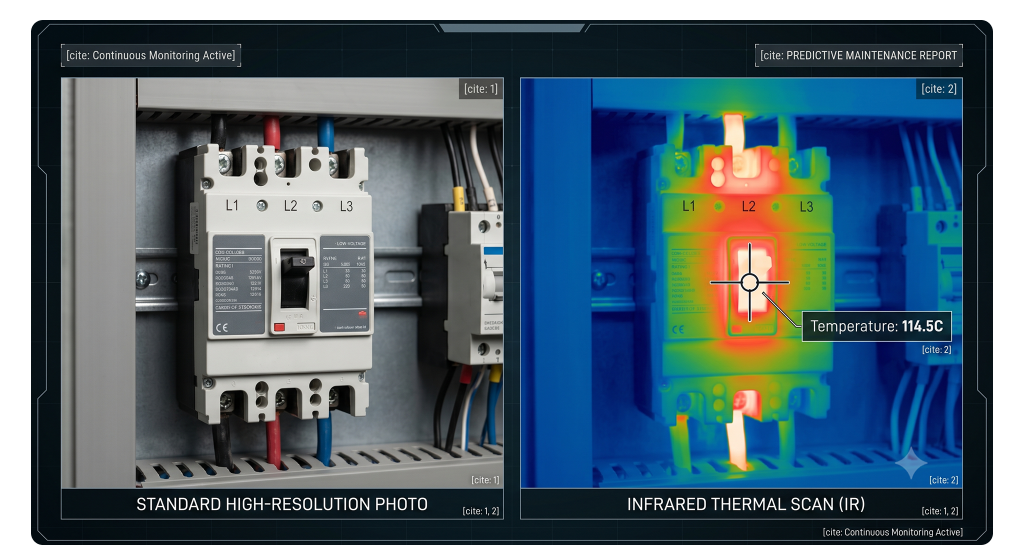
- The Cascading Thermal Loop: A loose busbar connection, a corroded cable termination, or uneven contact pressure in a circuit breaker pocket instantly increases the localized resistance ($R$). Under heavy current load, this increased resistance generates intense electrical resistance heat.
- Oxidation Acceleration: This localized heating accelerates the oxidation of the copper or aluminum conductors. Copper oxide is highly resistive compared to pure copper. This newly formed oxide layer drives the localized resistance even higher, creating a dangerous, compounding thermal-oxidative loop. If left uncorrected, the temperature at the connection will rise exponentially until the metal melts, triggering an explosive phase-to-phase arc flash or fire.
Scanning MV vs. LV Equipment
While the underlying physics of thermography remain consistent, the physical execution and safety protocols vary drastically depending on the voltage level of the target switchgear.
Low Voltage (LV) Panels ($400\text{ V}$)
For standard low-voltage switchboards, molded case circuit breakers, and motor control centers, executing LV panel thermography is relatively straightforward. With proper personal protective equipment (PPE), trained technicians can safely open panel doors to expose the internal busbars, cable terminations, and contactors directly to the infrared camera’s lens, ensuring a clear line of sight.
Medium Voltage (MV) Switchgear ($11\text{ kV} / 33\text{ kV}$)
For medium-voltage GIS or AIS switchgear, the stakes are exponentially higher. Opening a live $11\text{ kV}$ metal-clad cabinet door to execute an MV switchgear testing scan is exceptionally dangerous and is strictly prohibited by modern safety regulations. The prospective incident energy levels during an arc flash at this voltage can be instantly lethal, even for technicians wearing heavy, Category 4 arc-flash suits, requiring alternative, non-intrusive scanning methods.
The Critical Role of IR Windows
To solve the safety and access dilemmas associated with medium-voltage equipment, modern facilities utilize advanced retrofitting solutions.
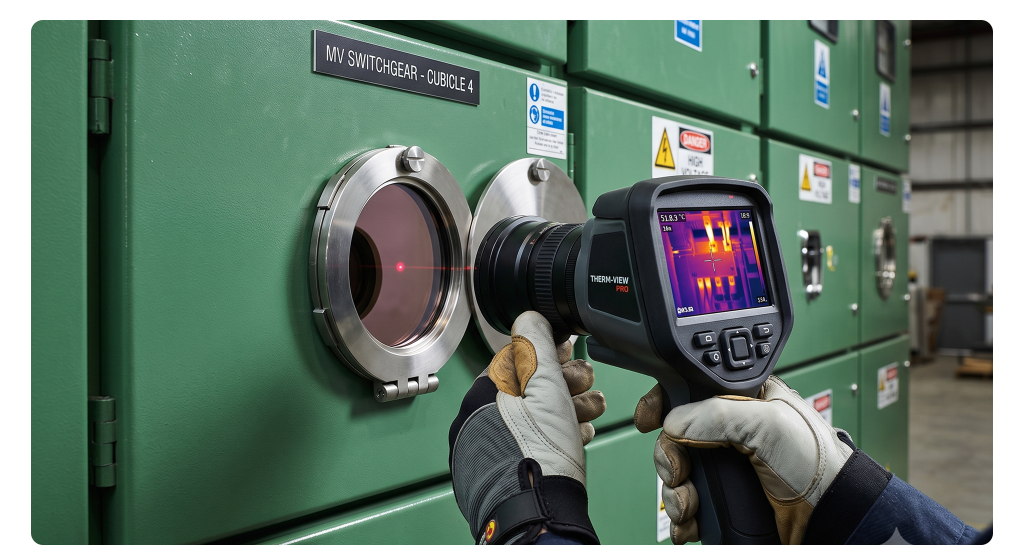
Engineers specify the installation of permanently mounted infrared windows switchgear accessories directly onto the metal doors or covers of critical MV panels. These specialized windows utilize custom, infrared-transparent crystalline optics (such as Calcium Fluoride or Germanium) sealed in a robust, industrial steel or aluminum frame.
- Safe closed-door scanning: These IR windows act as a physical barrier that completely isolates the technician from live, high-voltage conductors. During a routine scan, the thermographer simply slides back the protective metal cover of the window and points the camera through the crystal.
- The Efficiency Boost: This allows for rapid, highly detailed, and safe thermography scanning under full, live load conditions without requiring heavy, exhausting PPE suits, permit-to-work delays, or expensive plant shutdowns.
[Placement for Image 2]
The Load Dependency Rule
A common and highly expensive mistake in predictive maintenance programs is scheduling thermography scans during low-load periods, such as over weekends, during winter shutdowns, or right after commissioning before the facility has ramped up operations.
Thermography is entirely dependent on current flow. If there is no current passing through a loose connection, there is no $I^2 R$ heating, rendering the hotspot completely invisible to the camera.
- The 40% Minimum: The absolute thermography load requirement dictates that the target equipment must be operating at a minimum of $40\%$ of its rated capacity (ideally $>60\%$) for at least two hours before the scan begins.
- The Seasonal Trap: In the GCC, many critical assets, such as massive district cooling plants or heavy HVAC chillers, run near empty in the winter. Scheduling your annual electrical peak load testing in January will yield dangerously deceptive “healthy” reports. Loose terminal bolts will remain cold and hidden, only to fail catastrophically in July when the summer cooling demand forces the chillers to run at $100\%$ capacity under extreme ambient heat. Scans must be strategically scheduled to capture equipment performance under realistic, peak summer load conditions.
Emissivity and Reflection Challenges
An infrared camera does not physically measure temperature; it measures the intensity of infrared radiation emitted by an object and mathematically converts it into a temperature reading. For this conversion to be accurate, the thermographer must master two optical variables: Emissivity and Reflection.
- Emissivity ($\epsilon$): This is a measure of how efficiently an object radiates heat compared to a perfect blackbody ($\epsilon = 1.0$).
- The Problem: Clean, polished copper or aluminum busbars have incredibly low thermography emissivity (often below $0.10$). They are highly inefficient emitters.
- The Solution: If a thermographer points a camera at a bare copper joint, the temperature reading on the screen will be massively underestimated. Technicians must apply high-emissivity black electrical tape ($\epsilon = 0.95$) or specialized matte-finish paint to the target joint to secure accurate, reliable data.
- Reflection: Low-emissivity shiny surfaces act like infrared mirrors. The camera can easily detect the infrared reflection electrical energy of the thermographer’s own warm body or a nearby hot transformer, displaying it as a false “hotspot” on the screen. Certified, Category-II thermographers must actively adjust the camera’s reflected temperature and emissivity settings to filter out these optical illusions.
Interpreting the Delta-T (Temperature Difference)
Once a legitimate temperature anomaly is identified, engineers must systematically evaluate its severity to plan corrective actions. The industry standard methodology is the Delta-T ($\Delta T$) analysis, governed strictly by NETA thermography standards and NFPA 70B guidelines.
The $\Delta T$ is calculated in two ways:
- Phase-to-Phase ($\Delta T_{p-p}$): Comparing the temperature of the suspected hot termination against a healthy, adjacent phase carrying the same load.
- Phase-to-Ambient ($\Delta T_{p-a}$): Comparing the temperature of the hot joint against the ambient air temperature inside the cabinet.
$$\Delta T = T_{faulty} – T_{reference}$$
Severity Classification Matrix
| Delta-T (ΔTp−p) | Severity Level | Required Corrective Action |
| $1^\circ\text{C}$ to $3^\circ\text{C}$ | Minor (Class III) | Monitor trend. Re-scan during the next routine maintenance cycle. |
| $4^\circ\text{C}$ to $15^\circ\text{C}$ | Intermediate (Class II) | Plan repair. Schedule corrective maintenance during the next convenient planned shutdown. |
| $>15^\circ\text{C}$ | Critical (Class I) | Immediate danger. Schedule emergency shutdown to re-torque or replace components. |
Table: NETA classification guidelines for evaluating the severity of Delta-T electrical testing anomalies.
Mitigating Catastrophic Financial Risk
An undetected electrical hotspot is not merely a technical defect; it is a severe electrical fire risk that threatens the physical survival of your facility and your business continuity.
An unchecked $150^\circ\text{C}$ hotspot on a primary incoming $1600\text{ A}$ breaker terminal can melt down an entire main low-voltage distribution board within hours, causing site-wide blackouts, destroying upstream transformers, and triggering devastating structural fires.
- The Insurance Mandate: Because the financial consequences of such failures are so catastrophic, international underwriters and risk surveyors enforce strict mandates. Incorporating mandatory, documented annual thermographic surveys is an absolute requirement of modern Electric Insurance management protocols. If a facility experiences an electrical fire and the owner cannot produce certified, up-to-date thermography reports, the underwriter can flatly reject the claim, leaving the developer to absorb millions of dirhams in asset replacement and business interruption losses. The scan is your ultimate proof of technical due diligence to maintain active switchgear failure insurance validity.
Integrating Repairs into the Maintenance Schedule
Finding a hotspot is only half the battle; the true value of predictive maintenance lies in how systematically you resolve the identified defects.
Once a hotspot is logged in the thermography report, the data must be transferred directly into the plant’s Computerized Maintenance Management System (CMMS).
- The Repair Workflow: The CMMS electrical maintenance platform must automatically generate a high-priority work order detailing the exact equipment tag, the severity class, and the calculated $\Delta T$.
- The Outage Coordination: For Class I and Class II anomalies, engineers coordinate a safe, structured electrical planned outage. Technicians rack out the circuit breaker, ground the busbars, utilize calibrated torque wrenches to re-torque the loose connections to the manufacturer’s exact specifications, and replace any oxidized or pitted lugs.
- Establishing the Thermal Baseline: To maximize the value of this maintenance loop, expert Electrical Construction & Commissioning Management dictates executing comprehensive thermographic scans during the final commissioning phase of the project on Day 1. This establishes an unshakeable thermal baseline signature for every connection, allowing for precise comparative trend analysis over the multi-decade lifecycle of the asset.
Frequently Asked Questions (FAQ)
1. How often should thermographic inspections be conducted in the GCC?
Under standard European guidelines, annual thermography is sufficient. However, in the harsh climate of the GCC, heavily loaded critical assets should undergo thermographic inspection at least twice a year. The optimal schedule is once in the late spring (May) to catch early degradation before the summer peaks, and once during the peak summer load (August/September) to capture maximum thermal stress profiles.
2. Can an infrared camera see through closed metal switchgear doors?
No. Infrared radiation cannot penetrate solid metals, standard plastic sheets, or glass. To scan the internal components of medium-voltage switchgear without opening the doors, you must permanently install specialized, infrared-transparent crystal windows (such as Germanium or Calcium Fluoride) on the panel doors.
3. Why is the load on the electrical system so critical during an IR scan?
Because electrical heating is directly proportional to the square of the current ($P = I^2 R$). If an electrical circuit is running at very low load (such as $<20\%$ of its rated capacity), a highly resistive loose joint will not generate enough heat to be detected by the thermal camera, leading to a dangerous false-healthy reading.
4. What is the difference between a hot connection and an unbalanced phase load on an IR scan?
A hot connection (loose terminal) will show up as a highly localized, intense pinpoint hotspot radiating outward from the specific bolt or lug. An unbalanced phase load will show up as a uniform, warm temperature profile along the entire physical length of one specific phase conductor compared to the cooler adjacent phases.
5. Will insurance companies reject fire claims if thermography is skipped?
Yes, in many cases. Global property insurance underwriters increasingly include mandatory annual or semi-annual certified infrared thermography inspections as a warranty condition in their policies. Failing to perform and document these inspections represents a breach of policy terms, providing the insurer with legal grounds to deny a fire loss claim.
Proactive Heat Management
In the extreme, demanding climate of the GCC, execution of regular thermographic inspections is the single highest-ROI maintenance activity a facility manager can commission. A power system does not fail without warning; it signals its distress through heat. By systematically tracking these thermal anomalies, installing infrared windows on high-risk MV equipment, executing scans under peak summer loads, and strictly applying NETA Delta-T severity classifications, you protect your multimillion-dirham assets and guarantee human safety.
Relying on reactive repairs and ignoring the invisible thermal stress within your panels is a direct path to premature equipment failure, catastrophic fires, and devastating financial downtime.
Need to safeguard your critical power assets before the summer peak?
Do not gamble your facility’s safety or risk massive insurance rejections on unverified switchgear connections. Partner with our specialized engineering team to baseline your network health. Contact our electrical consultancy today to schedule a comprehensive, certified thermographic inspection. Elecwatts functions as your strategic regional partner, delivering the certified technical due diligence, advanced diagnostic mapping, and professional electrical maintenance UAE solutions required to keep your high-voltage infrastructure safe, compliant, and fully energized.
Contact Elecwatts today to secure your regional switchgear integrity.