

In the demanding high-voltage environments of the Gulf Cooperation Council (GCC), power transformers act as the silent anchors of energy distribution. To keep these multi-million-dollar assets operating efficiently, smart operators partner with a premier electrical engineering consulting firm to establish dynamic operations and maintenance (O&M) programs. At the core of this strategy is a rigorous understanding of the insulation system.
Liquid-immersed power transformers rely on highly refined mineral oil to perform a vital dual role: serving as a high-density dielectric insulator and functioning as a critical cooling medium that dissipates immense core heat.
However, maintaining the chemical integrity of this fluid in the Middle East is an uphill battle. The extreme summer temperatures of the GCC—often pushing ambient air past $50^\circ\text{C}$—coupled with high, saline coastal humidity, represent severe environmental stresses. These factors accelerate oil oxidation and thermal degradation significantly faster than in temperate climates.
Without a proactive system for transformer oil testing GCC protocols, microscopic anomalies will go undetected, leading to rapid insulation decay, catastrophic internal faults, and sudden, multi-million-dirham substation blackouts. Implementing a meticulous diagnostic schedule is the foundation of world-class electrical O&M Middle East operations.
Dissolved Gas Analysis (DGA): The Early Warning System
The most critical diagnostic test performed on transformer oil is Dissolved Gas Analysis (DGA). Much like a forensic blood test for a human patient, DGA detects and quantifies microscopic concentrations of fault gases dissolved within the fluid.
As thermal and electrical stresses act upon the mineral oil and the solid paper insulation, they break the chemical bonds of the hydrocarbon chains, releasing specific gaseous byproducts. The concentrations and ratios of these gases serve as direct indicators of active internal anomalies:
- Hydrogen ($\text{H}_2$): Primarily generated by low-energy electrical discharges, such as corona activity or partial discharge.
- Methane ($\text{CH}_4$) and Ethane ($\text{C}_2\text{H}_6$): Indicate low-to-medium thermal faults, pointing to localized overheating in the core or windings.
- Ethylene ($\text{C}_2\text{H}_4$): Represents high-temperature thermal faults (exceeding $700^\circ\text{C}$), such as severe oil overheating or localized hot spots.
- Acetylene ($\text{C}_2\text{H}_2$): The ultimate red flag. Acetylene is only generated during high-energy electrical arcing. The presence of even a few parts per million ($\text{ppm}$) of Acetylene indicates active, violent sparking inside the tank, requiring immediate de-energization.
- Carbon Monoxide ($\text{CO}$) and Carbon Dioxide ($\text{CO}_2$): Indicate the thermal breakdown of the solid Kraft paper insulation.
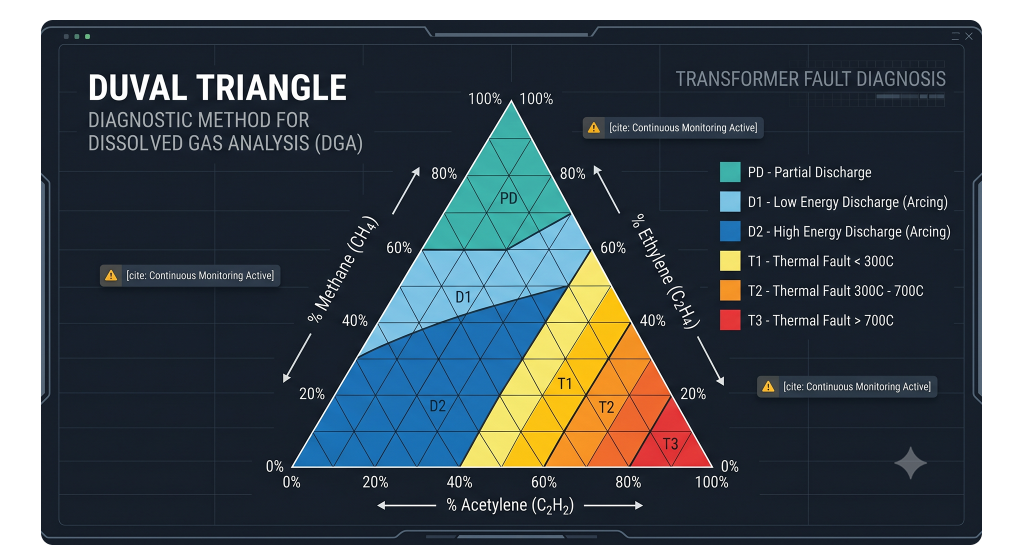
Executing comprehensive DGA testing transformer protocols allows chemists to perform advanced dissolved gas analysis interpretation utilizing internationally recognized standards like the Duval Triangle or Rogers Ratio method, pinpointing the exact physical nature of the internal fault long before a physical inspection is possible.
Dielectric Strength (Breakdown Voltage) in Humid Climates
The most fundamental electrical property of transformer oil is its dielectric strength, which measures the fluid’s physical ability to withstand electrical stress without breaking down.
During a standard lab test, a sample of oil is placed between two calibrated electrodes, and the AC voltage is slowly ramped up until an electrical spark jumps across the gap. This breakdown voltage testing is measured in kilovolts ($\text{kV}$).
- The High-Humidity Risk: The primary enemy of dielectric strength transformer oil is moisture. In the humid coastal environments of Dubai, Abu Dhabi, or Doha, microscopic water ingress into the transformer tank is a constant risk during routine maintenance or due to aging, degraded gaskets.
- The Impact of Water: Because water is highly conductive, even a tiny amount of moisture dramatically lowers the oil’s breakdown voltage. Under normal operating voltages, wet oil can allow a lethal arc flash to occur between the winding phases, leading to the instantaneous, explosive destruction of the transformer.
Moisture Content and Acidity Levels
Water does not only lower the breakdown voltage; it also acts as a chemical catalyst that aggressively degrades the solid paper insulation.
- Karl Fischer Titration: Chemists use the highly sensitive Karl Fischer titration method to measure the exact transformer oil moisture levels in parts per million ($\text{ppm}$). For a healthy $132\text{ kV}$ transformer, the moisture content should ideally be kept below $15\text{ ppm}$ to prevent insulation degradation.
- Oil Acidity Testing: Simultaneously, high operating temperatures cause the hydrocarbon molecules in the mineral oil to react with oxygen, forming organic acids and sludge. Conducting routine oil acidity testing (measured as the neutralization number in $\text{mg KOH/g}$) is critical. As the acidity rises, the acids chemically attack the metallic copper windings and accelerate the hydrolysis of the solid paper insulation. High acidity also leads to the formation of thick, conductive sludge that settles on the cooling radiators, restricting oil flow and causing the transformer to run dangerously hot.
Furan Analysis: Tracking Paper Degradation
A power transformer has two insulation mediums: the liquid mineral oil (which can be filtered or replaced) and the solid Kraft paper wrapped around the copper windings. Once the Kraft paper is destroyed, the transformer is physically dead and cannot be repaired.
Because you cannot physically open an energized transformer to inspect the paper, engineers rely on furan analysis transformer tests to evaluate its condition.
- The Chemistry of Decay: The solid Kraft paper is made of cellulose chains. As the paper degrades due to high heat, moisture, and acidity, the cellulose fibers break down, releasing unique oil-soluble chemical compounds known as furanic compounds—primarily 2-furfural ($\text{2-FAL}$).
- Lifespan Mapping: By measuring the exact concentration of furans in the oil, chemists can mathematically estimate the average Degree of Polymerization ($\text{DP}$) of the paper. A brand-new paper wrapper has a $\text{DP}$ value of approximately $1000$ to $1200$, while a paper that has suffered severe kraft paper degradation will display a $\text{DP}$ value below $250$, indicating the paper has become extremely brittle and is at risk of mechanically crumbling under the electromagnetic forces of a grid fault, leading to catastrophic failure.
Safe and Contamination-Free Sampling Methods
An analytical test is only as accurate as the sample itself. If the oil sample is contaminated during extraction, the resulting DGA and moisture reports will be completely inaccurate, leading to false alarms or missed faults.
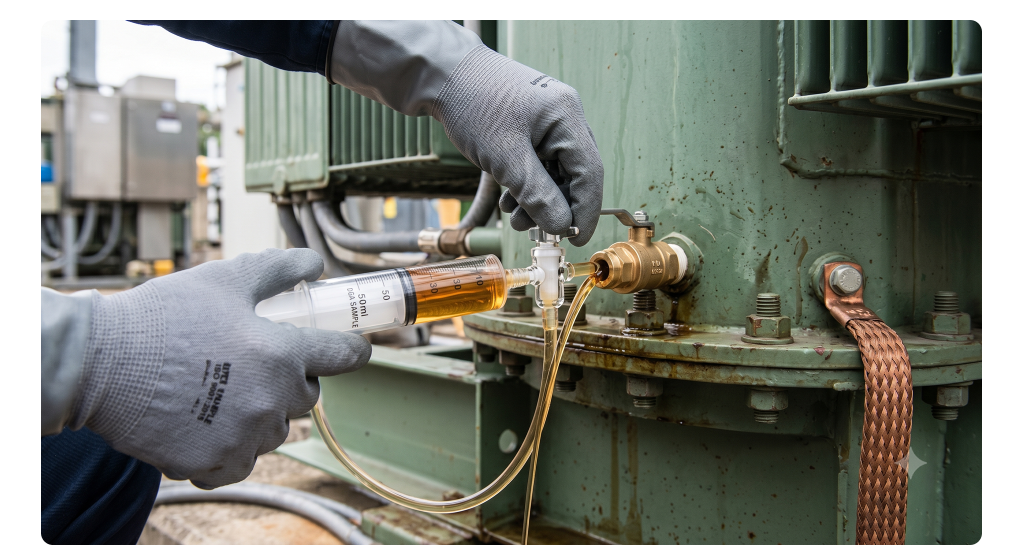
Executing a flawless transformer oil sampling procedure requires strict adherence to international standards (like ASTM D3613):
- Preventing Gas Loss: The sample must be drawn using a specialized, hermetically sealed glass syringe. Using plastic bottles or open containers is strictly prohibited for DGA, as dissolved gases will instantly escape into the atmosphere, and atmospheric moisture will contaminate the sample.
- Clearing the Valve: Before drawing the sample, the bottom drain valve of the transformer must be thoroughly flushed to clear out any stagnant oil, rust, or debris that has settled in the valve neck.
- Safety First: Because drawing oil is often executed while the transformer is energized and under load, technicians must enforce absolute electrical maintenance safety protocols. This includes wearing full Category-rated Arc Flash PPE, ensuring the transformer tank is solidly grounded, and utilizing insulated tools to prevent accidental short circuits near the high-voltage bushings.
Establishing a GCC-Specific Testing Frequency
Standard international guidelines (developed for mild, European climates) often recommend testing transformer oil once a year. In the punishing environment of the Middle East, this frequency is dangerously inadequate.
Establishing a robust transformer maintenance schedule requires calibrating your testing frequency to the harsh local climate and the criticality of the asset.
- The Summer Penalty: Heavily loaded transformers operating under peak summer loads (July/August) experience severe, continuous thermal stress. This accelerated aging requires a highly proactive GCC electrical maintenance frequency.
- The Recommended Roadmap: Critical substation transformers (Tier 1) should undergo comprehensive DGA testing at least semi-annually (once in the late spring before the summer load peaks, and once in the autumn to evaluate the summer’s thermal impact).
- Dynamic Auditing: Integrating updated power systems analysis into your substation O&M program is highly valuable. Running active load flow simulations proves if a transformer is consistently operating near or beyond its rated thermal boundaries, providing the empirical justification needed to increase your testing and inspection frequencies to prevent unexpected breakdowns.
Remediation: Filtering, Degassing, and Retrofilling
If your oil analysis reports come back with elevated moisture, low breakdown voltage, or high acidity, the oil must be remediated immediately to protect the solid paper insulation.
- On-Site Oil Filtration: For oil that has suffered moisture ingress or elevated gas levels, developers utilize mobile transformer oil filtration and degassing plants. This mobile rig connects directly to the transformer’s top and bottom valves while the unit is de-energized (or safely energized via specialized online systems). The oil is heated, passed through a high-vacuum chamber to extract dissolved water and fault gases, and pushed through fine particulate filters, restoring its dielectric strength.
- Acid Reclamation: If the oil’s acidity is high, the fluid must pass through active Fuller’s Earth filtration columns to chemically strip away the acids, polar compounds, and sludge.
- Degassing and Retrofilling: For heavily aged or severely degraded mineral oil, executing an oil degassing UAE style purification or a complete “retrofill” (extracting all old oil and replacing it with fresh, certified mineral or synthetic ester fluid) is often more cost-effective than attempting multiple filtration cycles, completely resetting the liquid insulation’s physical properties.
Managing Transformer Procurement and Replacement
In some unfortunate cases, furan analysis and trended DGA reports reveal that the internal paper insulation is severely degraded, and the transformer has reached its physical end of life. When this occurs, the asset cannot be saved by oil filtration.
Because you cannot operate a critically degraded transformer indefinitely without risking a violent explosion, developers must transition immediately to replacement planning. Managing a power transformer replacement is a complex, long-term logistical project.
Due to global supply chain constraints and the highly customized nature of high-voltage substation equipment, the lead time for a new transformer can easily range from 10 to 14 months. Implementing a robust Electrical Plant Procurement strategy is the only way to mitigate this risk. By leveraging your historical oil degradation trend data, engineers can initiate the custom procurement process and source a compliant, utility-approved replacement unit years in advance, avoiding catastrophic outages and securing your electrical plant sourcing pipeline.
Frequently Asked Questions (FAQ)
1. What is the most critical gas to monitor in a DGA test?
The most critical gas is Acetylene ($\text{C}_2\text{H}_2$). While gases like methane or ethylene indicate thermal overheating, Acetylene is only produced during high-energy electrical arcing (such as a short circuit or winding flashover). The presence of even $1\text{ ppm}$ of Acetylene requires immediate investigation, and higher levels demand an emergency shutdown of the transformer.
2. How does water get inside a sealed transformer?
Moisture primarily enters a transformer through two pathways: atmospheric breathing and chemical aging. During normal load cycles, the transformer heats up and expands, then cools down and contracts. This “breathing” cycle can draw in highly humid ambient air through degraded gaskets or the conservator tank’s breather if the silica gel is saturated. Additionally, the chemical degradation of the solid paper insulation itself releases water as a byproduct.
3. What is “Furan Analysis” and how does it predict transformer life?
Furan analysis measures the concentration of oil-soluble furanic compounds (primarily 2-furfural) that are released as the transformer’s solid paper insulation decomposes. Because the paper wrapped around the copper windings cannot be replaced, measuring furans allows chemists to calculate the paper’s remaining mechanical strength (Degree of Polymerization), accurately predicting when the transformer is reaching its end of life.
4. What is the difference between oil filtration and oil reclamation?
Oil filtration (vacuum dehydration and degassing) is a physical process that removes suspended water droplets, dissolved moisture, and fault gases from the oil. Oil reclamation (using Fuller’s Earth) is a chemical process designed to remove dissolved acids, polar contaminants, and sludge that have formed due to oil oxidation, restoring the oil’s chemical neutrality and color.
5. Why can’t I use a plastic bottle to collect a DGA oil sample?
Plastic is highly permeable to gases. If you collect an oil sample in a plastic bottle, the light fault gases dissolved in the oil (like hydrogen and acetylene) will rapidly diffuse through the plastic walls and escape into the air before the sample reaches the lab. Furthermore, the plastic can leach chemicals into the oil, corrupting the test results. DGA samples must be collected in hermetically sealed glass syringes.
Preserving Your Heaviest Asset
Executing routine, highly precise transformer oil testing is the defining factor that separates a highly resilient, safe, and cost-effective substation from an operational disaster zone. A power transformer is the single most expensive asset in your electrical network. While a new transformer costs millions of dirhams, a comprehensive annual or semi-annual oil testing program costs a mere fraction of a percent of that capital expenditure.
By systematically tracking dissolved gases, maintaining high dielectric strength, neutralizing acidity, and mapping paper health via furan analysis, you protect your infrastructure, eliminate the risk of catastrophic fires, and extend the physical lifespan of your assets by decades.
Relying on generic maintenance schedules and ignoring the chemical warning signs of your oil is a direct path to premature equipment failure and catastrophic blackouts.
Need to baseline your substation health?
Do not gamble your facility’s safety or risk massive insurance rejections on unverified equipment. Partner with our specialized regional engineering team to establish a rigorous, utility-compliant testing program. Elecwatts functions as your strategic regional partner, delivering the certified technical due diligence, advanced system simulations, and comprehensive electrical engineering consulting required to manage your assets flawlessly, ensuring your substation asset management program keeps your infrastructure safe and fully energized.
Contact Elecwatts today to secure the chemical health and operational reliability of your power transformers.