

In the high-stakes environment of Middle Eastern infrastructure and industrial development, ensuring the absolute reliability of the electrical grid is paramount. When designing massive power plants, heavy industrial facilities, or integrating utility-scale renewable energy, engaging a specialized power system analysis consultancy in Dubai is a fundamental requirement long before construction begins. At the heart of this rigorous engineering process is a highly complex simulation known as transient stability analysis.
Transient stability is defined as the power system’s ability to remain in a state of operating equilibrium, specifically, maintaining synchronism, after being subjected to a major, sudden disturbance. In simpler terms, it determines whether the grid will safely “bounce back” after a massive shock or if it will collapse into a cascading blackout.
As the Gulf Cooperation Council (GCC) rapidly expands its electrical footprint, transitioning from isolated national grids to a highly integrated, cross-border mega-grid laden with complex industrial and renewable loads, the margin for error has vanished. Understanding transient stability analysis GCC mandates and the physics of power grid synchronism is no longer just a concern for utility operators; it is a critical project gateway for developers, EPC contractors, and industrial facility managers aiming to secure grid connection approvals in the region.
What Triggers a Transient Disturbance?
A power system operating in a steady state is a delicate balance of mechanical power input (from turbines) and electrical power output (to consumers). A transient disturbance is any event that violently and suddenly upsets this balance, injecting massive amounts of kinetic or electrical energy into or out of the system in fractions of a second.
Common Sources of Grid Shock
The most common electrical transient triggers include:
- Severe Short-Circuit Faults: A three-phase fault on a main transmission line causes voltage to plummet to near zero, momentarily trapping generated power and causing generator rotors to accelerate wildly.
- Loss of a Major Transmission Line: If a critical 400kV line trips, the power it was carrying must instantly reroute through adjacent, potentially lower-capacity lines, causing severe power swings.
- Loss of Generation: The sudden tripping of a 600MW gas turbine forces all other generators on the grid to instantaneously pick up the slack, dropping system frequency.
The GCC Climate Multiplier
In the Gulf, environmental factors drastically increase the probability of a short circuit grid disturbance. The combination of fine desert dust, highly saline coastal humidity (creating “Sabkha” conditions), and infrequent but heavy seasonal fogs creates a conductive paste on high-voltage insulators. This leads to unexpected and violent “flashovers”, massive short circuits that act as severe transient shocks to the regional grid, necessitating highly robust stability margins in facility design.
The Role of the GCC Interconnection Authority (GCCIA)
The electrical landscape of the Middle East was forever altered by the establishment of the GCC Interconnection Authority (GCCIA). This monumental engineering achievement linked the national grids of Kuwait, Saudi Arabia, Bahrain, Qatar, the UAE, and Oman via a 400kV super-grid.
The Double-Edged Sword of Interconnection
The primary goal of the GCCIA is to allow member states to share power reserves during emergencies, drastically improving overall reliability. However, interconnected power systems Middle East introduce new layers of dynamic complexity.
- Cross-Border Power Swings: Because the grids are now physically synchronized, a massive fault at a petrochemical plant in Jubail (Saudi Arabia) can cause measurable frequency and voltage oscillations in Abu Dhabi (UAE).
- The Stability Mandate: To protect the entire peninsula, the GCCIA grid stability codes are exceptionally stringent. Any large-scale project, whether a new desalination plant, an aluminum smelter, or an Independent Power Producer (IPP), must prove through exhaustive transient stability studies that its internal operations or potential faults will not inject unstable, undamped oscillations into the broader GCC interconnector.
When Do Local Utilities Mandate TSA?
While small commercial buildings can connect to the grid with a simple load schedule, heavy infrastructure faces a much higher regulatory barrier. Local utility providers act as the gatekeepers, and they wield transient stability analysis as their primary diagnostic tool.
Triggers for Mandatory Studies
You will be required to submit a formal Transient Stability Study to authorities like DEWA (Dubai), SEC (Saudi Arabia), or TRANSCO (Abu Dhabi) under specific conditions:
- Independent Power Producers (IPPs): Any facility generating power to sell back to the grid (conventional or renewable) must prove it will remain stable during grid faults.
- Massive Industrial Loads: Facilities with extremely large dynamic loads, such as steel mills using electric arc furnaces or district cooling plants with multi-megawatt chiller motors.
- Large Substation Connections: Projects requiring direct connections to the 132kV, 380kV, or 400kV transmission networks.
Strict Grid Code Compliance
The DEWA transient stability requirement and SEC grid code compliance documents explicitly define the scenarios that must be modeled. For instance, the SEC Grid Code mandates that a facility must demonstrate “Fault Ride-Through” (FRT) capability, proving that its generators or large motors will not trip offline even if the grid voltage drops to zero for 150 milliseconds due to a transmission fault.
Generator Rotor Angle Stability Explained
To truly understand a transient stability study, one must look at the physics of the machines generating the power. The core focus of TSA is rotor angle stability.
The Physics of Synchronism
A synchronous generator consists of a spinning magnetic rotor inside a stationary stator. The magnetic field of the rotor locks onto the rotating magnetic field of the stator (the grid). As long as they spin together, the system is stable.
- The Disturbance: When a severe short circuit occurs, the generator can no longer export its electrical power to the grid. However, the massive mechanical turbine (steam or gas) is still pushing the rotor with immense force. Because the power cannot escape electrically, it converts into kinetic energy, causing the rotor to physically accelerate and swing forward, increasing its “rotor angle” relative to the grid.
The Equal-Area Criterion and CCT
Engineers use the “equal-area criterion” to mathematically determine if the rotor will swing too far and “slip a pole” (lose synchronism).
- Critical Fault Clearing Time (CCT): This is the most vital output of a transient stability study. The critical fault clearing time is the absolute maximum number of milliseconds a short circuit can exist on the grid before the generator rotor accelerates past the point of no return. If the study calculates a CCT of 120 milliseconds, but the facility’s circuit breakers take 150 milliseconds to open and clear the fault, the facility is inherently unstable and the design will be rejected by the utility.

The Impact of Massive Motor Starts
Transient stability is not only about managing utility grid faults; it is also about managing the severe shocks a facility inflicts upon itself.
The Industrial Shockwave
In the GCC’s sprawling petrochemical, oil and gas, and water desalination sectors, the use of massive induction and synchronous motors is ubiquitous. Starting a single 10MW compressor motor Direct-On-Line (DOL) can pull an inrush current six to eight times its normal operating current.
- The Transient Event: This large motor transient acts essentially like a controlled short circuit. It instantly pulls the local voltage down, stressing the facility’s internal power generation or its main utility transformers.
- The Requirement for Simulation: Sophisticated modern power system analysis is required to model the dynamic inertia of the motor and the response of the grid. The study must prove that this massive industrial grid impact won’t cause the voltage to collapse so severely that other running motors in the plant stall, or that the facility’s own backup generators are dragged out of synchronism.
Renewable Energy Integration Challenges
The GCC is undergoing a historic energy transition. Projects like the Mohammed bin Rashid Al Maktoum Solar Park in Dubai and the Sudair Solar PV project in Saudi Arabia are injecting gigawatts of clean energy into the grid. However, this shift fundamentally alters the physics of grid stability.
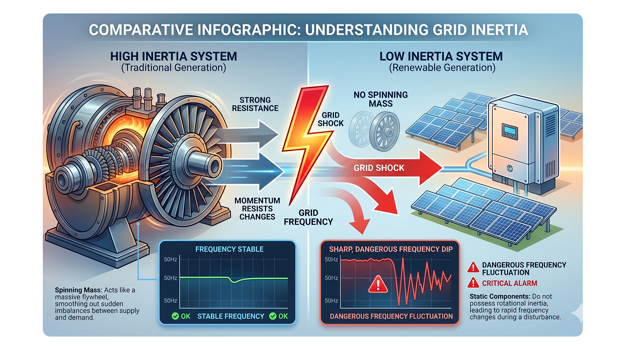
The Loss of Rotating Inertia
Traditional gas and steam turbines are massive, heavy pieces of spinning metal. This physical mass provides “kinetic inertia”, a natural shock absorber that physically resists sudden changes in grid frequency during a transient disturbance.
- Inverter-Based Resources (IBRs): Solar panels and Battery Energy Storage Systems (BESS) have zero moving parts. They interface with the grid entirely through power electronics (inverters). Because they lack physical mass, they provide zero natural inertia.
- The New Instability: As the GCC grid replaces heavy, spinning turbines with lightweight inverter based resource transient technologies, the grid’s overall inertia drops. This makes the entire network far more “twitchy” and susceptible to rapid frequency collapse during a fault. Achieving renewable energy grid stability now requires highly advanced transient studies to design “synthetic inertia” control algorithms and grid-forming inverters that mimic the stabilizing behavior of traditional generators.
Mitigation Strategies: Fast Fault Clearing
If a transient stability study reveals that a proposed facility is unstable (i.e., its Critical Clearing Time is too short), engineers must implement robust mitigation strategies before the utility will grant an NOC (No Objection Certificate).
Upgrading the Protection Ecosystem
The most direct way to ensure a facility survives a transient event is to remove the fault from the system faster than the rotor can swing out of control.
- Ultra-Fast Relays: Engineers will specify the upgrade of standard protection relays to advanced, microprocessor-based distance and differential relays that can detect a fault in under a single cycle (less than 20 milliseconds).
- Advanced Circuit Breakers: Implementing high-speed SF6 or vacuum circuit breakers capable of physically interrupting massive fault currents in 2 to 3 cycles ensures fast fault clearing, artificially keeping the fault duration well below the calculated CCT limit.
Power System Stabilizers (PSS)
For facilities with on-site generation, engineers often deploy a power system stabilizer. This is an advanced control loop added to the generator’s Automatic Voltage Regulator (AVR). The PSS detects the subtle, dangerous power oscillations that follow a transient shock and intelligently modulates the generator’s magnetic excitation field to actively dampen those swings, forcefully pulling the rotor back into a stable, steady state.
Mitigating Major Project Risks
Transient instability is not an abstract mathematical concept; it is the precursor to catastrophic physical and financial destruction.
The Cost of Instability
If a transient stability study is ignored or poorly executed, and a generator loses synchronism during a grid fault, the results are violent. The out-of-phase magnetic forces can literally shear the solid steel shaft of a multi-million-dollar turbine in half. Furthermore, the resulting voltage collapse will cascade, triggering a massive power plant blackout risk that can leave industrial complexes dead in the water for days.
Protecting the Investment
Because the consequences of failure are so astronomically high, integrating stability studies is a key component of sustainable infrastructure insurance management for mega-projects. Global insurance underwriters and financial lenders increasingly demand comprehensive transient stability reports as proof of technical due diligence before they will underwrite the electrical infrastructure insurance policies for IPPs and heavy manufacturing facilities in the Gulf. The study is the ultimate proof that the asset is engineered to survive the worst-case scenario.
Frequently Asked Questions (FAQ)
1. What is the difference between Load Flow Analysis and Transient Stability Analysis?
A Load Flow analysis takes a “snapshot” of the electrical grid under calm, normal, steady-state operating conditions to ensure cables aren’t overloaded. Transient Stability Analysis is a dynamic “video” simulation; it models how the grid violently reacts in the milliseconds and seconds after a massive shock (like a short circuit) to see if it survives or collapses.
2. How does the harsh GCC climate affect transient stability?
The extreme heat, high coastal humidity, and pervasive desert dust in the GCC create a highly conductive layer on high-voltage transmission line insulators. During heavy morning dew or fog, this layer can cause sudden, massive “flashovers” (short circuits). Because these faults happen more frequently in the Gulf than in temperate climates, facilities must be engineered with higher stability margins to survive these repeated shocks.
3. Do I need a transient stability study for a standard commercial high-rise in Dubai?
Generally, no. Standard commercial high-rises that only consume power from the DEWA grid (without generating their own synchronized power or running massive industrial motors) do not possess the dynamic characteristics that cause transient instability. These studies are reserved for power plants, heavy industries, and very large substations.
4. What is “Fault Ride-Through” (FRT) for solar plants?
Historically, if the utility grid voltage dropped due to a fault, solar inverters were programmed to instantly disconnect for safety. However, if a massive 1GW solar park disconnects simultaneously, the grid will collapse. FRT is a strict grid code requirement mandating that solar plants must “ride through” the voltage dip, staying connected and actively injecting reactive power to help the grid stabilize and recover.
5. How long does a transient stability study take to complete?
A comprehensive study for a large industrial facility or power plant typically takes 4 to 8 weeks. It requires gathering highly detailed, proprietary dynamic modeling data (like inertia constants and exciter time constants) from the manufacturers of the specific generators, motors, and inverters being used, before the complex software simulations can even begin.
Conclusion & Next Steps: Securing Utility Approvals
In the modern, highly interconnected, and rapidly evolving electrical landscape of the GCC, stability is the ultimate currency of reliability. As the region pushes the boundaries of engineering with gigawatt-scale renewables, massive industrial complexes, and cross-border super-grids, the tolerance for grid disturbances has plummeted.
Transient Stability Analysis is no longer an optional academic exercise reserved for utility operators; it is a mandatory, rigorous gateway for heavy infrastructure development. It is the definitive proof that your facility will not just consume or generate power, but that it will act as a resilient, stable citizen of the broader electrical grid, capable of surviving the inevitable shocks of the real world.
Does your upcoming mega-project require utility clearance?
Navigating the complex dynamic grid codes of DEWA, SEC, and the GCCIA requires profound analytical expertise. Do not let your project stall at the utility approval gateway. Contact our electrical engineering consulting firm for expert transient modeling and compliance reporting. As a premier transient stability consultant, Elecwatts guarantees your facility is engineered for unshakeable resilience, securing your GCC utility approval swiftly and efficiently.
Contact Elecwatts today to safeguard your project’s grid stability and operational future.