

Establishing high-capacity commercial, technological, or financial hubs in Dubai’s special economic zones requires a highly coordinated engineering approach. Partnering with a certified electrical engineering services provider is essential to secure approvals quickly and avoid costly project delays. Dubai’s Free Zones—such as the Dubai International Financial Centre (DIFC), Dubai Silicon Oasis (DSO), and the TECOM Group districts—operate as independent jurisdictions designed to foster global business.
However, this administrative independence introduces a unique dual-authority engineering challenge. While standard municipal projects only require utility approval, projects situated inside these economic zones must strictly achieve Dubai Development Authority compliance or Free Zone authority clearances alongside standard DEWA regulations.
Failing to harmonize these overlapping standards during the design phase results in immediate rejection at the permit gate. To build a compliant, zero-downtime power network in these districts, consultants must master the localized technical nuances of each zone’s specific grid codes, spatial constraints, and energy efficiency mandates. This guide outlines the essential technical criteria for executing successful UAE free zone electrical design submissions.
DIFC: The High-Stakes Financial Hub
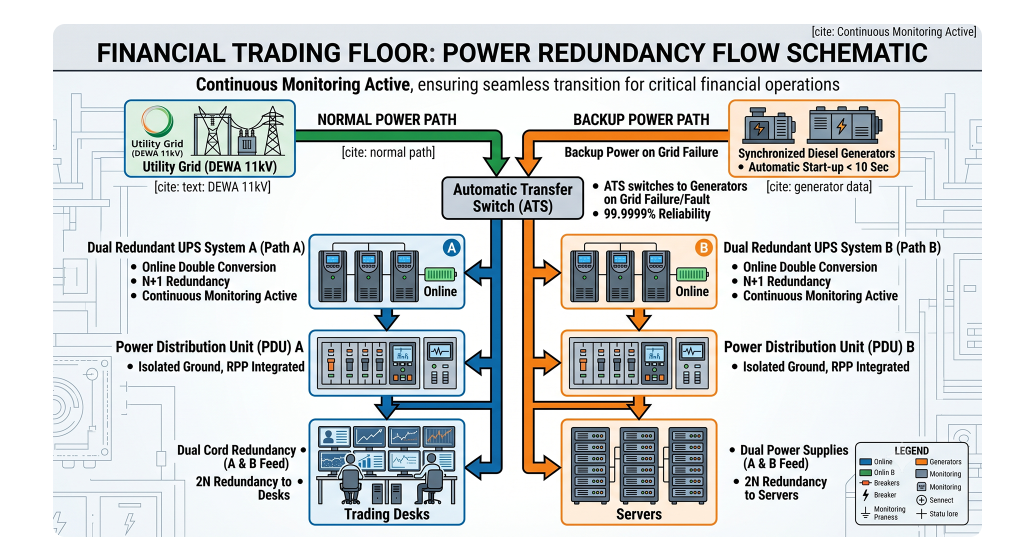
The Dubai International Financial Centre (DIFC) is the financial engine of the Middle East, housing global investment banks, hedge funds, and active trading floors. In this high-intensity commercial environment, power reliability is directly tied to millions of dollars in transaction security. The DIFC electrical requirements leave absolutely zero room for voltage dips, let alone localized outages.
To insulate critical financial operations from grid disturbances, designs must incorporate Tier III or Tier IV data-center-level redundancy architectures.
- The Sizing Formula: Sizing redundant system capacity relies on establishing the active power ($P$) demand of the trading floor under full load:
- $$P = \sqrt{3} \times V \times I \times \cos\phi$$
- Where $V$ is the nominal line voltage ($400\text{ V}$), $I$ is the full-load current, and $\cos\phi$ is the system power factor (which must be maintained above $0.95$).
- System Redundancy: Critical trading assets must be supported by a minimum of $2(N+1)$ redundant Uninterruptible Power Supply (UPS) systems and high-speed Automatic Transfer Switches (ATS).
- Backup Power: The financial center backup power ecosystem relies on massive, synchronized standby diesel generators. These generators must be engineered with advanced digital controllers capable of synchronizing and picking up the entire critical load within $15$ seconds of a main utility failure, ensuring seamless operational continuity for global financial networks.
Dubai Silicon Oasis (DSO): The Smart City Blueprint
Dubai Silicon Oasis (DSO) functions as a dedicated high-tech free zone, serving as a real-world testing ground for advanced smart-city technologies, internet-of-things (IoT) ecosystems, and sustainable infrastructure.
Designing a project in this zone requires executing advanced smart city electrical integration:
- EV Charging Infrastructure: Unlike standard developments where EV chargers are often optional or retrofitted, Dubai Silicon Oasis electrical guidelines mandate integrated, building-wide electric vehicle charging infrastructure. The main distribution boards must be sized on Day 1 to accommodate dedicated EV charging sub-panels equipped with automated load-management systems to prevent peak-demand grid overloading.
- Smart Building Controls: All buildings must incorporate high-level Building Management Systems (BMS) that interface directly with the zone’s centralized smart-grid monitoring networks.
- Lighting Efficiency: Lighting designs must utilize high-efficiency LED fixtures coupled with daylight harvesting sensors and occupancy controls to minimize overall energy footprints, ensuring the facility operates as a highly efficient node within the broader DSO smart grid.
TECOM Group: Media, IT, and Mixed-Use Loads
The TECOM Group encompasses several of Dubai’s most famous specialized districts, including Dubai Internet City, Dubai Media City, and Dubai Studio City. These zones host unique, highly sensitive electrical loads that differ drastically from standard office buildings.
Media studios, broadcasting towers, and massive server farms run on non-linear power electronics that inject severe harmonic currents back into the local distribution network.
- The Harmonic Menace: This media broadcasting electrical load profile creates a high risk of current and voltage distortion, which can overheat transformers, trip sensitive breakers, and corrupt data signals.
- Mitigating with Analysis: To protect your assets, executing a comprehensive power systems analysis during the detailed design phase is mandatory. Engineers must model the prospective Total Harmonic Distortion of current ($THD_I$):
- $$THD_I = \frac{\sqrt{\sum_{h=2}^{\infty} I_h^2}}{I_1} \times 100\%$$
- Where $I_1$ is the fundamental current ($50\text{ Hz}$) and $I_h$ represents the harmonic current components. To comply with strict TECOM electrical standards, designs must incorporate active harmonic filters (AHF) at the main switchboards to suppress these non-linear currents, protecting sensitive broadcast and IT systems from electromagnetic interference.
Navigating Dual-Authority NOC Approvals
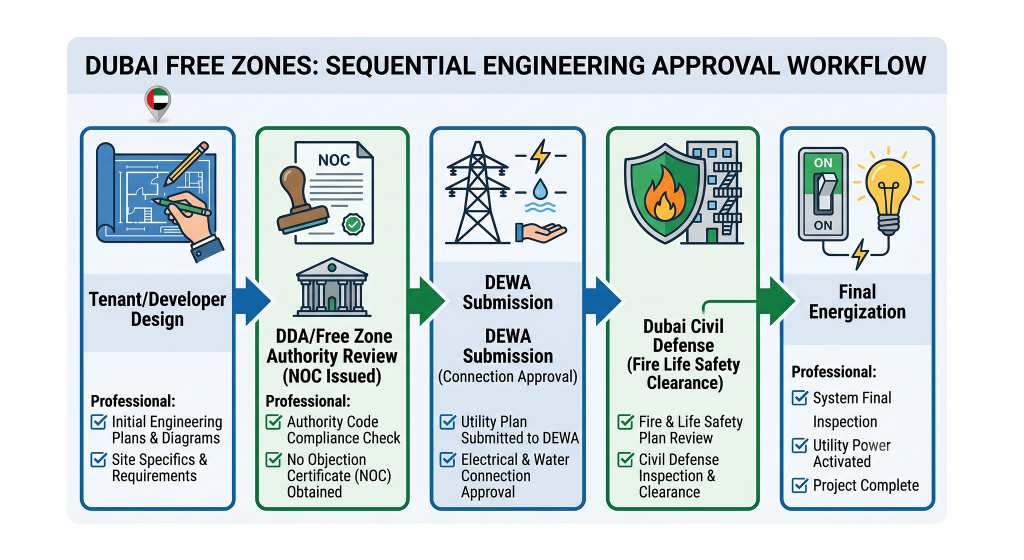
Building in a Dubai Free Zone is a bureaucratic coordination challenge. You cannot simply submit your plans to DEWA and begin construction; you must navigate a strict, sequential dual-authority approval workflow.
The DDA Gateway
For zones under the jurisdiction of the Dubai Development Authority (DDA), the consultant must first submit the complete architectural and MEP design package through the centralized DDA portal. Securing the DDA NOC approval is a mandatory prerequisite.
- The Review: DDA engineers will rigorously review the design to ensure it complies with zone-specific spatial planning, environmental guidelines, and fire-safety codes.
- The Utility Handshake: Only after the DDA stamps the drawings can the file be submitted to DEWA to secure the final Dubai free zone building permit and power allocation, meaning that any uncoordinated submittal will deadlock your project at the very first gateway.
Spatial Planning in Premium Real Estate
In the premium commercial districts of Dubai’s Free Zones, physical floor space is exceptionally valuable. Every square meter allocated to utility rooms represents lost leasable area for the developer.
This financial reality creates an intense engineering challenge: compact substation design.
- Compressing the Footprint: Standard DEWA substation layouts are historically generous. However, within high-density high-rises, designers must work closely with utility engineers to compress the high rise electrical room layout to the absolute minimum compliant footprint.
- The Engineering Solutions: This is achieved by utilizing compact Gas Insulated Switchgear (GIS) instead of bulky Air Insulated Switchgear (AIS), deploying high-density dry-type transformers that require less spatial clearance than oil-filled units, and optimizing the structural cable-entry basements. These spatial saving measures must be executed without violating the mandatory maintenance and emergency escape clearances required by the DDA.
District Cooling Electrical Integration
To optimize energy efficiency and conserve valuable space, almost all major commercial towers within UAE Free Zones prohibit the installation of individual, roof-mounted HVAC chillers. Instead, they rely on centralized District Cooling networks managed by entities like Empower.
Achieving Empower electrical compliance is a major design milestone.
- The Boundary Limit: While Empower provides the chilled water to the building’s boundary, the developer must design and power the internal heat exchangers, secondary variable-speed chilled water pumps, and motorized control valves.
- The Power Demand: This district cooling power supply represents a massive, highly inductive electrical load. The sub-main distribution boards feeding the chilled water pumps must be sized with robust motor-starting capabilities (such as variable frequency drives or soft-starters) to prevent localized voltage dips during pump activation, ensuring continuous, reliable cooling across the entire facility.
Al Safat and Green Building Mandates
Sustainability is not an option in Dubai’s Free Zones; it is a legally enforced design parameter. All new developments must comply with Dubai’s Al Safat Green Building Evaluation System.
Executing a compliant Al Safat electrical design fundamentally alters your power distribution layout:
- Tenancy Sub-Metering: The guidelines mandate comprehensive Dubai green building sub-metering protocols. Designers must install smart meters at every single tenant retail space, office floor, and major mechanical load (such as the district cooling pumps and elevator banks). This granular tracking prevents waste and enables landlords to implement precise energy billing.
- Renewable Integration: Furthermore, commercial developments must allocate roof space for solar PV systems under DEWA’s net-metering schemes, directly offsetting the building’s peak cooling loads during the hot summer days.
Fast-Track Fit-Outs and Tenant Modifications
Free Zone commercial buildings feature a highly transient tenant landscape. A trading firm in DIFC or a software developer in DSO may lease a space, execute an intensive fit-out, and relocate within a few years, requiring constant modification of the building’s electrical system.
Managing these rapid changes requires strict change control.
- Preventing System Collapses: A common hazard during a commercial fit out electrical project is the unauthorized addition of server racks, specialized lighting, or high-density pantry equipment by a tenant’s contractor. If executed without a formal tenant load modification Dubai study, these added loads can easily overload the building’s local risers, cause harmonic instability, or trip the main upstream breakers.
- Technical Due Diligence: Implementing expert Project Lead Engineering & Management is vital during the fit-out phase. Dedicated engineering management ensures that all tenant submittals are technically reviewed, load-balanced, and safely integrated into the building’s master single line diagram (SLD) without compromising the overall grid stability.
Frequently Asked Questions (FAQ)
1. What is the difference between DDA and DEWA during the approval process?
The DDA (Dubai Development Authority) is the master planning and zoning authority that governs land use, spatial clearances, and general building codes within specific Dubai Free Zones. DEWA (Dubai Electricity and Water Authority) is the physical utility provider that reviews electrical loads, issues the final electrical connection approvals, and installs the physical tariff meters. You must secure DDA NOC approval before submitting to DEWA.
2. Why do TECOM districts require specialized harmonic filtering?
Districts like Dubai Media City and Internet City host dense concentrations of non-linear electrical loads, including media broadcasting gear, LED studio lighting, and IT server banks. These devices distort the standard AC waveform, injecting high-frequency current harmonics back into the system. Specialized active harmonic filters are required to prevent this harmonic noise from overheating transformers and corrupting sensitive data signals.
3. What are the specific EV charging requirements in Dubai Silicon Oasis?
To support its smart-city mandate, Dubai Silicon Oasis requires commercial and residential developments to integrate dedicated EV charging infrastructure into their baseline designs. This involves allocating physical parking bays for chargers, sizing the main switchboards to handle the added electrical load, and deploying smart load-management systems to throttle charging speeds during peak building demand hours.
4. How does Al Safat impact tenancy sub-metering in commercial buildings?
Under the Al Safat green building codes, developers are prohibited from using flat-rate energy billing for tenants. The electrical design must incorporate independent, smart sub-meters for every individual commercial tenant and major mechanical load. This granular tracking allows tenants to monitor and pay for their exact consumption, actively promoting energy conservation.
5. Can I use standard oil-filled transformers in a high-rise Free Zone tower?
Generally, no. Due to extreme fire safety risks, standard oil-filled transformers are prohibited inside high-rise structures. Designers must specify dry-type (cast resin) transformers for indoor substations and high-rise electrical rooms. Dry-type units utilize self-extinguishing insulation materials, eliminating the risk of oil leaks, smoke inhalation, and catastrophic oil fires in dense commercial zones.
Mastering Free Zone Engineering
Successfully executing electrical designs in Dubai’s premier special economic zones requires an uncompromising technical mastery of both standard utility codes and complex, developer-specific regulations. From the high-stakes, Tier IV power redundancy demands of DIFC trading floors to the smart EV integration of Dubai Silicon Oasis and the severe harmonic mitigation needs of TECOM’s media districts, every single connection must be engineered with unyielding precision.
Relying on generic designs or ignoring the strict, dual-authority approvals of the DDA and DEWA is a direct path to design rejection, procurement waste, and catastrophic commissioning delays.
Bidding on or managing a commercial development in a Dubai Free Zone?
Do not let overlapping authority standards or complex load requirements stall your project execution. Partner with an independent specialist to secure your design approvals and power connections seamlessly. Contact our specialized team to review your drawings. As a premier Dubai free zone electrical consultant and leading DDA engineering firm, Elecwatts delivers the certified technical due diligence, advanced system simulations, and professional utility coordination required to power your free zone assets flawlessly.
Contact Elecwatts today to secure your dual-authority approvals and energize your commercial infrastructure.