

The UAE’s luxury hospitality sector represents the absolute pinnacle of global architectural and engineering achievement. For hotel developers, main contractors, and MEP coordinators, executing projects in this space is a masterclass in balance. The primary challenge of UAE hospitality electrical design is that the heavy power infrastructure must be completely invisible to the high-paying guest, yet incredibly robust behind the scenes.
To execute this flawlessly, partnering with a premier electrical system design firm early in the master planning phase is essential to ensure that guest comfort is never compromised. Electrical engineers face a demanding dual mandate: they must satisfy the opulent, zero-downtime performance standards mandated by international five-star hotel operators, while maintaining strict, absolute hotel DEWA compliance. Failing to harmonize these requirements during the layout phase leads directly to rejected submittals, long delays in utility connection approvals, and expensive, late-stage structural modifications.
Load Estimation and Substation Sizing for Resorts
Sizing the utility connection for a luxury resort is a high-stakes calculation. These properties operate as self-contained micro-cities featuring massive, continuous power demands driven by 24/7 central chiller plants, extensive landscape illuminations, specialized water features, and dense guest-room loads.
Executing a highly accurate hotel load calculation DEWA submission requires moving beyond basic building codes. If an engineer simply applies standard commercial load factors, the calculated demand will be heavily overestimated, forcing the developer to pay exorbitant capital fees for oversized substations.
The maximum demand ($MD$) must be mathematically modeled by dividing the facility into highly detailed load groups, applying realistic diversity factors ($DF$):
$$MD = \sum_{i=1}^{n} (P_{i} \times DF_{i}) + P_{cooling} \times DF_{cooling}$$
Where $P_i$ represents the connected load of specific categories (such as guest rooms, kitchens, and public areas), and $P_{cooling}$ represents the peak cooling load.
Sizing the resort substation design requires close coordination with DEWA planning engineers. The substation plots must be strategically located to minimize low-voltage voltage drops while remaining accessible for utility maintenance vehicles without violating the developer’s premium landscape aesthetics.
Zero-Blackout Reliability: Backup Power and ATS Design
For a five-star hospitality asset, a power outage is more than an inconvenience; it is a catastrophic brand failure that compromises guest safety and transaction security. Achieving zero-blackout reliability is an absolute non-negotiable design criteria.
The hospitality backup power network relies on a highly synchronized, multi-generator standby power plant.
- The Sizing Philosophy: The generator farm must be sized to pick up $100\%$ of the building’s life-safety loads (mandated by Abu Dhabi or Dubai Civil Defense) plus “essential hospitality loads” (such as commercial kitchen refrigeration, guest elevators, and IT server rooms).
- The Transition Sequence: When a main utility grid failure is detected, the automated system must command the generators to start, synchronize, and bring the essential busbars online within $15$ seconds. This rapid transition is managed by high-speed ATS switchgear UAE systems equipped with closed-transition (make-before-break) capability to allow seamless transfers back to DEWA utility power without causing localized voltage dips or rebooting delicate guest-room IT networks.
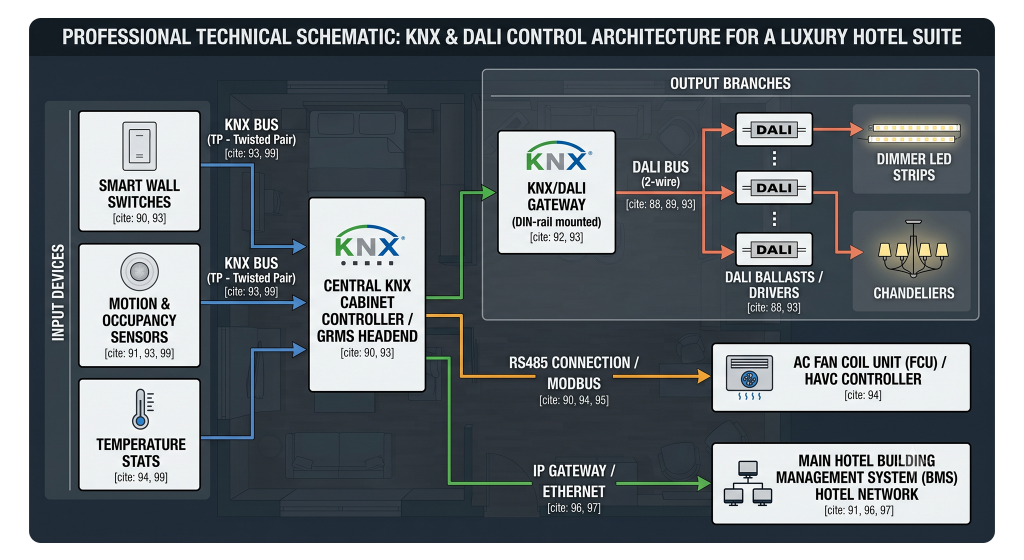
Specialized Lighting Control: DALI, KNX, and Al Safat
A luxury hotel’s atmosphere is defined entirely by its lighting design. Managing thousands of delicate lighting channels—spanning custom crystal chandeliers in the grand ballroom, high-output facade projectors, and low-voltage pathway LED strips—requires a highly sophisticated control architecture.
Hospitality projects have overwhelmingly moved away from legacy, manual switching in favor of digital DALI lighting control (Digital Addressable Lighting Interface) and KNX-based automation protocols.
- The Integration Benefit: These addressable networks allow hotel operators to pre-program dynamic lighting “scenes” that adjust automatically based on the time of day, astronomical clock positions, and occupancy levels.
- The Green Compliance: Implementing these advanced dimming and control networks is not merely an aesthetic choice; it is a mandatory requirement to satisfy the energy-efficiency parameters of Dubai’s Al Safat green building rating system, which enforces strict limits on overall Lighting Power Density (LPD) in commercial spaces.
Taming Massive Kitchen and Industrial Laundry Loads
The heart of a hotel’s back-of-house operations—the main production kitchens and the underground industrial laundry facility—presents some of the most challenging electrical loads on the property.
Commercial kitchens feature high concentrations of heating, refrigeration, and ventilation equipment. Designing a safe commercial kitchen electrical layout requires calculating precise thermal diversity factors and specifying chemical-resistant, high-temperature cables.
- The Harmonic Menace: Industrial laundry facilities operate massive washing wheels, dryers, and ironing rollers. These machines utilize high-power electric heaters and heavy Variable Frequency Drives (VFDs) to ramp motor speeds.
- The Mitigation Remedy: This intense hotel laundry load profile is highly inductive and injects severe harmonic distortion back into the hotel’s electrical grid. Executing a comprehensive power systems analysis during the detailed design phase is mandatory. Engineers specify dedicated active harmonic filters (AHF) and detuned capacitor banks at the laundry distribution boards to suppress these non-linear currents, protecting sensitive IT networks and guest-room electronics from electromagnetic interference.
Guest Room Management Systems (GRMS) Integration
The modern hotel room operates as a highly integrated smart-grid node. This is achieved by deploying a dedicated Guest Room Management System (GRMS).
A compliant GRMS electrical design interfaces directly with the guest room’s localized electrical distribution board:
- The Welcome Scene: When a guest slides their key card into the door lock or enters the room, the GRMS detects the event and triggers a pre-programmed welcome scene—gradually opening motorized curtains, activating warm ambient lighting, and ramping the AC fan speed.
- The Energy Saver: The primary financial benefit of a smart hotel room IoT network is energy conservation. When the guest leaves the room and the motion sensors register zero occupancy for a pre-set duration (typically 15 minutes), the GRMS overrides the climate and lighting systems—switching off all lights, disabling non-essential power outlets (such as the TV and vanity plugs), and setting the AC thermostat to an eco-mode temperature, drastically lowering the property’s overall carbon footprint.
Wet Zones: Spas, Pools, and Extreme Earthing Rules
Water and electricity are a lethal combination. In the high-humidity, wet environments of hotel spas, hammams, and outdoor resort swimming pools, the safety requirements enforced by DEWA are absolute.
Designing for these high-risk areas requires strict adherence to wet area earthing DEWA wiring regulations:
- Zone Classification: Spas and pools are divided into Zones 0, 1, and 2, which dictate the permissible voltage levels and placement of electrical assets. In Zone 0 (inside the pool water), only safety extra-low voltage (SELV) devices operating at $\le 12\text{ V AC}$ or $\le 30\text{ V DC}$ are permitted.
- Equipotential Bonding: All metallic components in and around the pool structure—including ladders, grab rails, drain covers, and structural reinforcement steel—must be physically welded or bolted to a continuous copper equipotential bonding grid. This grid connects directly to the dedicated spa earth bar, ensuring no touch or step voltages can occur.
- Safety Breakers: All circuits feeding wet-area lighting or water pumps must be protected by highly sensitive residual current devices (ELCBs) rated at $10\text{mA}$ or $30\text{mA}$ trip currents.
- Ingress Protection: All landscape and water feature luminaires must satisfy strict IP rating outdoor electrical guidelines, with underwater fixtures requiring a minimum rating of IP68 (dust-tight and continuous immersion protection) to guarantee absolute guest safety.
[Placement for Image 2]

Valet and Guest EV Charging Infrastructure
As electric vehicle adoption surges in the GCC, luxury hotels must provide reliable, high-speed charging infrastructure as a baseline service for their guests and valet parking operations.
Integrating an EV charger hotel valet or guest-parking hub requires managing massive, intermittent electrical loads:
- Grid Impact: Installing ten $22\text{ kW}$ AC chargers and two $150\text{ kW}$ DC fast chargers represents a massive, highly concentrated dynamic load that can easily overload the hotel’s incoming utility feed during peak evening check-in hours.
- The Solution: The hotel electrical design must comply strictly with DEWA Green charger guidelines. Engineers must deploy an active Dynamic Load Management (DLM) controller. The DLM system continuously monitors the hotel’s active connected load. When the hotel experiences low demand (such as late at night), it routes full power to the chargers. Conversely, during peak banquet or dinner hours, the DLM automatically throttles the EV charging speeds, preventing the main hotel incomer circuit breakers from tripping.
Architectural Coordination: Hiding the Infrastructure
A luxury hotel’s guest areas must feel completely detached from the industrial reality of power generation and distribution. This creates a constant design battle between the interior designer and the electrical engineer.
The challenge of architectural electrical coordination is a primary coordination milestone:
- The Aesthetic Challenge: Interior designers cannot tolerate visible distribution boards (DBs), cable trays, or access hatches in public lobbies, wood-paneled corridors, or marble clad spa spaces.
- The Engineering Reality: All DBs, isolation switches, and transformers must be fully accessible for maintenance and emergency operations. Engineers must work closely with the design team to conceal panels inside flush-mounted, custom-finished wooden wall cabinets that blend into the paneling, or locate panels within dedicated service corridors.
- The Spatial Boundary: These aesthetic concealment solutions must be executed without violating the mandatory DEWA room clearances and emergency access codes, which require unobstructed, continuous clear space around all switchboards.
Frequently Asked Questions (FAQ)
1. What are the specific ELCB requirements for hotel guest bathrooms in Dubai?
Under strict DEWA and RSB regulations, all electrical circuits serving power outlets and hair dryers inside hotel guest bathrooms must be protected by highly sensitive Residual Current Devices (ELCBs) with a rated trip current of $30\text{mA}$ or lower. For highly sensitive spa massage tables, jacuzzis, and steam rooms, the protection must be upgraded to $10\text{mA}$ to guarantee absolute safety against minor current leakages.
2. How does the Al Safat rating system affect lighting design in Dubai hotels?
Al Safat enforces strict energy-conservation targets. It impacts lighting design by mandating maximum allowable Lighting Power Density (LPD) limits (measured in $\text{W/m}^2$) for different hotel zones. To comply, designers are prohibited from using inefficient halogen lamps, requiring a $100\%$ transition to high-efficacy LED lighting coupled with occupancy sensors, daylight harvesting sensors, and automated KNX dimming controls.
3. Can I use standard PVC conduits inside a luxury hotel’s ceiling space?
Generally, no. Due to extreme fire-safety risks and smoke toxicity guidelines enforced by the Dubai Civil Defense (DCD), all electrical cables routed through public corridors, lift shafts, and ceiling spaces must be enclosed in galvanized steel conduits, metallic cable trunking, or must utilize certified Low-Smoke Zero-Halogen (LSZH) cable insulations. PVC conduits are typically restricted to concrete slab embedment.
4. What is a Guest Room Management System (GRMS) and how does it reduce energy consumption?
A GRMS is an intelligent control system dedicated to managing the lighting, climate, and drapery inside a guest room. It reduces energy consumption by using motion sensors and door contacts to detect occupancy. When a guest leaves the room, the system automatically enters an “eco-mode” which disables non-essential power outlets, switches off all lights, and adjusts the AC fan speed and temperature to minimize cooling energy.
5. Why are dry-type transformers preferred over oil-filled units in high-rise hotel designs?
Dry-type (cast resin) transformers are preferred—and often mandated—for indoor and high-rise electrical rooms because they do not utilize flammable mineral oil as an insulating medium. Dry-type units utilize self-extinguishing epoxy resin, completely eliminating the risk of oil leaks, dense toxic smoke inhalation, and catastrophic oil fires in dense guest areas, satisfying strict Civil Defense codes.
Engineering Five-Star Experiences
Successfully executing electrical designs in the UAE’s high-stakes hospitality sector requires an uncompromising technical mastery of both standard utility codes and complex, luxury operator-specific regulations. From the high-density power requirements of centralized kitchens and industrial laundry facilities to the smart-room integrations of the GRMS, the delicate dimming controls of DALI/KNX networks, and the life-safety mandates of wet-area earthing, every single watt must be engineered with absolute, unyielding precision.
Relying on generic commercial designs or ignoring the strict, overlapping regulations of the DDA, Civil Defense, and DEWA is a direct path to design rejection, project delays, and massive construction rework.
Bidding on or developing a new hotel or resort in the UAE?
Do not let complex load requirements or dual-authority clearances stall your progress. Partner with an independent specialist to secure your design approvals and power connections. Contact us to schedule a certified engineering review. As a premier hotel electrical consultant Dubai trusts and a leading UAE resort engineering partner, our electrical engineering consulting team delivers the certified technical due diligence, advanced system simulations, and professional utility coordination required to power your hospitality assets flawlessly.
Contact Elecwatts today to secure your hotel approvals and energize your luxury infrastructure.