

One of the most persistent dilemmas in GCC infrastructure planning is the choice between underground (UG) and overhead (OH) cable systems. Historically, this decision has often been driven by a single metric: the upfront price tag. Overhead lines, with their lower initial material and installation costs, frequently win the bid.
However, viewing this decision through the narrow lens of initial CAPEX is a strategic error. The true business case reveals itself only when we analyze the Total Cost of Ownership (TCO) over a minimum 5-year horizon. In the unique environment of the Gulf Cooperation Council (GCC)—characterized by extreme heat, abrasive sand, and high power demands—reliability and maintenance costs heavily influence the final equation. This 2026 analysis breaks down the underground vs overhead cable cost GCC debate to help you make an informed decision for your next project.

The GCC Context: Why Climate and Environment Dictate Costs
In Europe or North America, the choice might be aesthetic. In the GCC, it is existential. The region’s environmental challenges disproportionately impact the longevity and operational costs of electrical infrastructure.
- Overhead Challenges: High humidity and coastal salinity in areas like the UAE and Eastern Saudi Arabia accelerate corrosion on towers and insulators. Frequent sandstorms can cause insulator flashovers, requiring expensive washing cycles.
- Underground Challenges: The cable installation desert environment faces issues with soil thermal resistivity (dry sand traps heat), requiring larger cables or special backfill to prevent overheating.
Need a specific design for your environment? Explore our Cable Design Engineering services.
Breaking Down the Cost Components
To understand the TCO, we must decouple the costs into Capital Expenditure (CAPEX) and Operational Expenditure (OPEX).
1. Upfront Capital Expenditure (CAPEX)
- Underground: This is the heavy lifter. Costs include extensive civil works (trenching, horizontal directional drilling), conduit systems, imported thermal bedding sand, joint bays, and the cable itself, which is significantly more expensive due to complex insulation and armor.
- Overhead: Costs are driven by towers/poles, concrete foundations, insulators, conductors, and securing the Right-of-Way (ROW).
- The Reality: In the GCC, UG CAPEX is typically 60% to 100% higher than OH for the same voltage and capacity.
2. Annual Operational Expenditure (OPEX) & “Soft Costs”
- Underground: Once buried, the cable is largely protected from the elements. OPEX is very low, primarily involving route patrols and monitoring. However, if a fault does occur, finding and fixing it is expensive and slow.
- Overhead: These assets live in the harsh elements. Overhead line maintenance OPEX is high, driven by visual inspections, thermographic surveys, rust treatment, and insulator washing.
- Soft Costs: This includes the “Value of Lost Load.” Overhead lines are more susceptible to weather-related trips. For a factory, one day of outage can cost more than the price difference between the two systems.
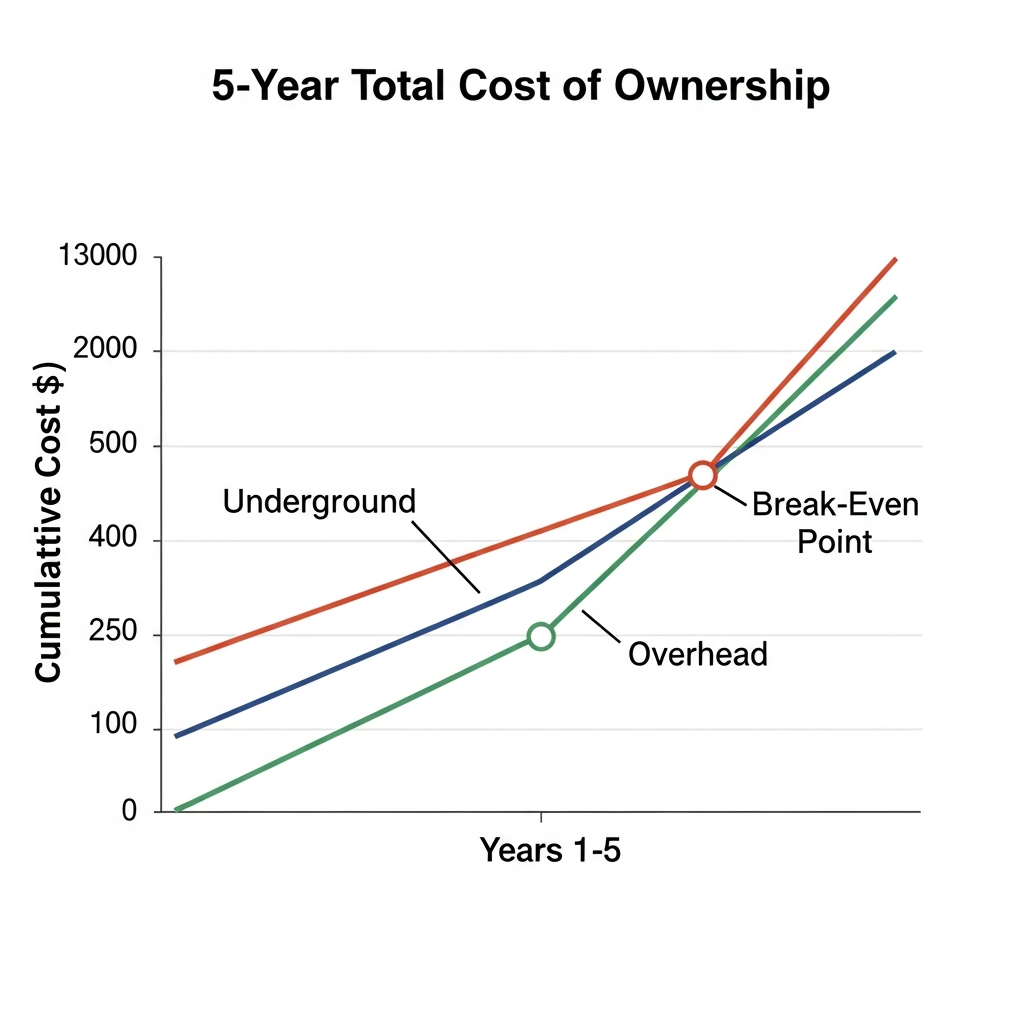
The 5-Year TCO Comparison: A Model Scenario
Let’s look at a simplified model for a 1km, 33kV medium-voltage feeder.
| Cost Category | Overhead Line (Estimated) | Underground Cable (Estimated) | Notes |
| Initial CAPEX | $ X | $ 1.8X | UG requires extensive cable trenching cost and civil works. |
| Annual OPEX | $ Y | $ 0.15Y | OH requires regular cleaning and inspection; UG is minimal. |
| Outage Cost Risk | High | Low | OH is exposed to storms, sand, and wildlife interference. |
| 5-Year TCO | $ (X + 5Y) + Risk | $ (1.8X + 0.75Y) | The crossover point where UG becomes competitive often occurs within 5-7 years for critical infrastructure. |
Decision Framework: Which Project Type is Best Suited For Each?
There is no single winner. The “right” choice depends on your specific project priorities.
Choose Overhead Cables When:
- The project is highly CAPEX-sensitive with a tight initial budget.
- The route passes through non-urban, open desert areas where aesthetics and land value are not primary concerns.
- Fast fault repair is critical (overhead faults are visible and easier to access).
- Soil conditions are extremely rocky, making excavation prohibitively expensive.
Choose Underground Cables When:
- Reliability and uptime are non-negotiable (e.g., data centers, hospitals, continuous process industries).
- The project is in an urban center, high-end development, or an area with strict planning restrictions.
- The environment is highly corrosive (coastal) or prone to severe sandstorms that threaten overhead line corrosion.
- Long-term (10+ year) total cost of ownership electrical cables is the primary financial driver.
Frequently Asked Questions (FAQs)
Q1: How does soil thermal resistivity in the GCC affect underground cable costs?
Sandy, dry soil acts as a thermal insulator—it traps heat. If the soil cannot dissipate the heat generated by the cable, the cable will overheat and fail. To prevent this, engineers must either “derate” the cable (use a larger, more expensive size for the same current) or import expensive thermal backfill material to surround the cable. Both options increase CAPEX.
Q2: Are underground cables more reliable than overhead lines in the Gulf?
They have different reliability profiles. Underground cables are immune to wind, sand, and most accidental contact, making their frequency of outages much lower. However, when a fault does occur (e.g., due to excavation damage or joint failure), the duration of the outage is much longer because locating and repairing a buried fault is difficult. Overhead lines trip more often but can be fixed quickly.
Q3: What is the typical lifespan comparison?
A well-constructed and maintained UG cable system can last 40-50 years with minimal degradation. An OH line in the harsh GCC environment may require significant component renewal (pole painting, insulator replacement) after 20-30 years.
Q4: Can we mix both systems in one project?
Yes, a hybrid approach is very common. For example, developers often use OH lines to bring power across long stretches of empty desert and then transition to UG cables (via a terminal pole or substation) for the final kilometer into a built-up facility or city. This balances cost and aesthetics effectively.
Conclusion
There is no universal best choice between underground and overhead systems. The optimal solution is a complex function of project geography, finance, risk tolerance, and long-term operational strategy. While overhead lines offer an attractive upfront price, the hidden costs of maintenance and reliability risks in the GCC climate can tip the scale in favor of underground solutions over time.
Choosing the right cable system requires a detailed, project-specific TCO study that accounts for your unique site conditions and reliability needs. Our cable design engineering specialists can build this model and deliver the most economically efficient design for your 2026 project.
Contact us for a feasibility assessment to ensure your infrastructure investment is built to last.