

In the race to achieve ambitious decarbonization targets, multinational corporations and heavy industries across the Middle East face a massive physical constraint: they simply do not have enough rooftop space to generate the gigawatts of renewable energy required to offset their massive carbon footprints. To navigate this spatial limitation, forward-thinking enterprises are turning to an expert electrical consultancy to facilitate a revolutionary financial mechanism: the Virtual Power Purchase Agreement (VPPA).
A VPPA allows a corporate buyer to purchase renewable energy at a massive scale from an off-site solar or wind farm located hundreds of kilometers away. As the regulatory landscape of the Gulf Cooperation Council (GCC) evolves to support decentralized energy trading and corporate sustainability goals, the VPPA GCC market is poised for explosive growth. Establishing a robust virtual power purchase agreement UAE or Saudi Arabia strategy solves the geographical problem, but it introduces highly complex electrical engineering, metering, and grid integration challenges. This guide explores the rigorous electrical infrastructure required to make virtual energy trading a physical, reliable reality.
Financial vs. Physical Power Flow Explained
To understand the engineering behind a VPPA, one must first clarify the fundamental difference between a direct, physical Power Purchase Agreement (PPA) and a virtual one.
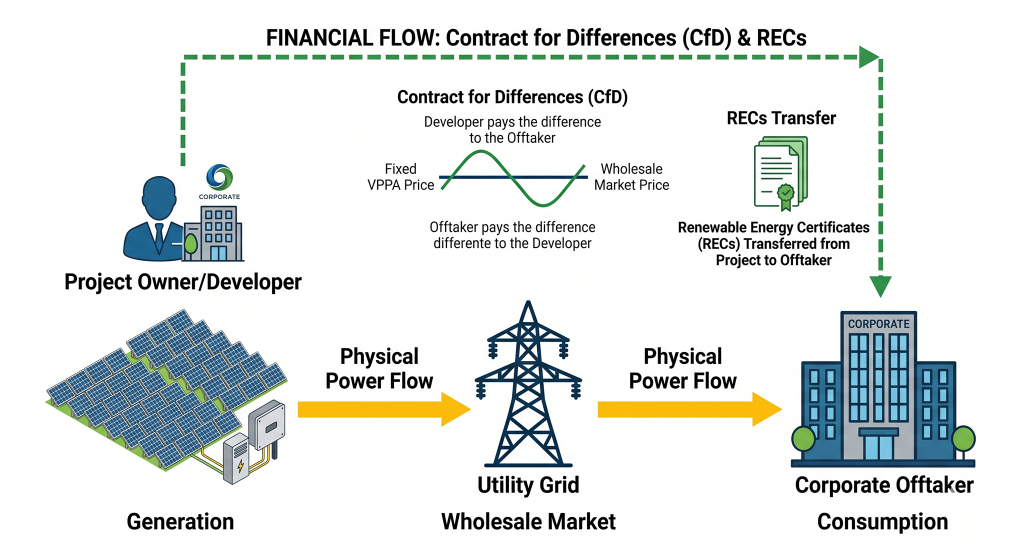
In a traditional, behind-the-meter PPA, a solar array is built on your factory’s roof, and the power flows directly into your main distribution board. A VPPA, conversely, operates as a “contract for differences.”
- The Physical Reality: In a VPPA, the remote solar farm does not physically deliver electricity to the corporate buyer. Instead, the VPPA physical power flow is injected directly into the public utility grid (e.g., DEWA or SEC) at the site of generation.
- The Financial Reality: The corporate buyer continues to draw its physical power from its local utility connection as normal. However, through a complex contract for differences electrical structure, the financial attributes of the generated power—and most importantly, the green environmental attributes—flow virtually to the corporate buyer, offsetting their carbon emissions on paper.
Advanced Metering and Telemetry Systems
Because the corporate buyer and the solar farm are not physically connected, the entire VPPA relies on absolute, indisputable data accuracy. The utility, the generation asset, and the corporate buyer must all be perfectly synchronized.
This demands highly sophisticated VPPA smart metering infrastructure. Utilities require the installation of Class 0.2s high-accuracy, bi-directional smart meters at the generation plant’s point of interconnection. These meters do not just measure total kWh; they integrate with advanced telemetry electrical systems to track the off-site generation minute-by-minute. This continuous data logging is transmitted via secure SCADA networks to the grid operator, ensuring that every single electron injected into the grid is precisely accounted for, forming the mathematical baseline for the financial crediting and settlement process.
Grid Connection and Power Quality Compliance
Even though the power is deemed “virtual” for the corporate buyer, the multi-megawatt remote solar or wind farm must still physically connect to the national grid. The utility views this connection exactly as it views any other heavy generation asset.
Securing a utility scale grid connection requires uncompromising engineering. The developer cannot simply pump uncontrolled solar power into the national network. They must execute rigorous power systems analysis to prove that the massive array of solar inverters will not destabilize the local grid. This simulation dictates the design of the plant’s active harmonic filters and reactive power compensation equipment, guaranteeing VPPA power quality compliance by ensuring the injected power perfectly meets DEWA or SEC’s stringent limits for Total Harmonic Distortion (THD) and voltage fluctuation.
Renewable Energy Certificate (REC) Accounting
The ultimate prize for the corporate buyer in a VPPA is not the electricity itself, but the right to claim that their electricity is green. This claim is legally verified through the generation of Renewable Energy Certificates (RECs).
In the Middle East, the standard is the International REC (I-REC). For every 1 Megawatt-hour (MWh) of renewable energy injected into the grid, one I-REC GCC is minted. The electrical metering data discussed earlier is the foundational proof required by global registries to issue these certificates. Flawless renewable energy certificate tracking requires an unbroken chain of digital custody—from the physical current transformer at the solar plant’s main incomer to the secure servers of the I-REC registry—allowing the corporate buyer to transparently prove their net-zero claims to stakeholders and international auditors.
Substation Design for Remote Generation Sites
A VPPA is typically utilized for massive energy offsets, meaning the generation asset is usually a 50MW+ utility-scale facility located in a remote desert area where land is abundant.
Exporting this sheer volume of power requires a dedicated, custom-engineered utility scale solar substation.
- The Engineering Scope: The design involves massive step up transformer design, elevating the low voltage generated by the solar inverters (typically 600V or 800V) up to medium or high transmission voltages (33kV, 132kV, or higher).
- The Infrastructure: It requires heavy-duty SF6 or vacuum switchgear, complex grid synchronization panels, and highly sophisticated protection relays capable of detecting transmission line faults and instantly isolating the solar farm to protect both the grid and the valuable generation asset.
Mitigating Grid Volatility and Curtailment
The GCC power grid is a delicate balancing act of supply and demand. On a mild, sunny winter day, the grid may experience a massive oversupply of solar energy with simultaneously low air-conditioning demand.
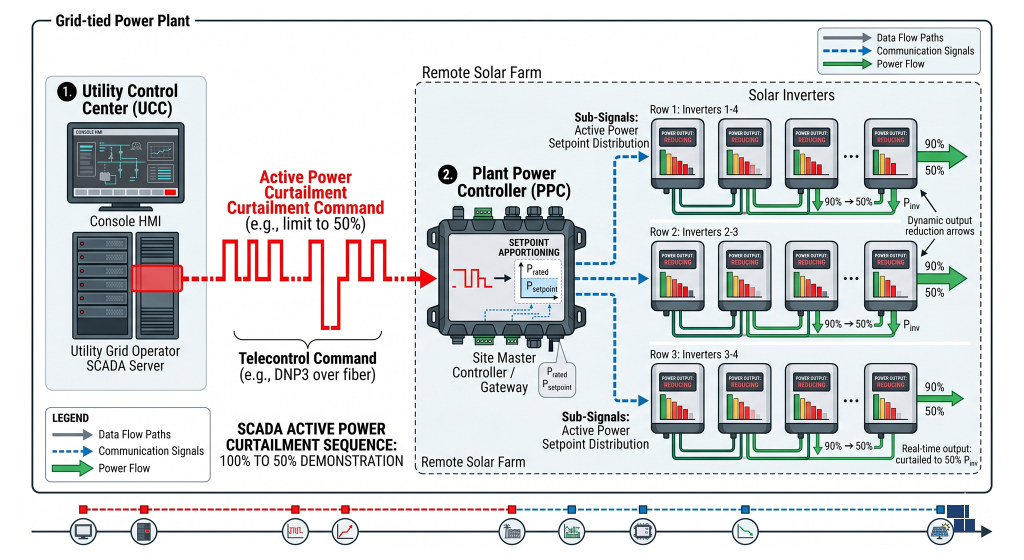
During these periods of grid volatility, utilities reserve the right to “curtail” (shut off or throttle down) independent solar farms to prevent grid over-voltage or frequency collapse. Solar curtailment GCC regulations are a massive risk for VPPAs. If the utility shuts off the solar farm, the plant generates no MWh, mints no RECs, and the corporate buyer misses their carbon offset targets.
- The Mitigation Strategy: Electrical engineers design complex Plant Power Controllers (PPC) and interface protection panels to manage grid oversupply mitigation. These controllers listen for active power curtailment signals via the utility SCADA network and instantly, automatically throttle the output of the solar inverters down to the exact percentage demanded by the grid operator, ensuring compliance without physically tripping the main breakers.
Cybersecurity for Grid Data Transmission
In a VPPA, data is quite literally money. The continuous, real-time transmission of generation data from the remote solar plant to the utility and the corporate buyer’s financial dashboard presents a massive attack surface.
Smart grid cybersecurity is no longer an IT afterthought; it is a fundamental electrical design requirement. Vulnerabilities in the SCADA or telemetry network could allow malicious actors to spoof generation data (artificially inflating REC generation) or hack the Plant Power Controller to maliciously trip the plant offline. Securing VPPA data transmission requires implementing robust IT/OT (Information Technology / Operational Technology) convergence protocols, including hardware firewalls, end-to-end encryption for IEC 61850 communications, and strictly segregated VLANs to protect the physical generation asset from digital threats.
Financial Assurances and Risk Mitigation
While a VPPA is a financial instrument, it is ultimately anchored to physical, spinning fans or silicon panels baking in the desert sun. If that physical equipment fails, the financial structure collapses.
VPPA financial risk is severe. If the remote plant suffers a catastrophic electrical failure—such as a main step-up transformer explosion or a massive inverter bank failure—the plant cannot deliver the contracted MWh. The corporate buyer faces massive financial exposure and the failure of their public sustainability mandates.
To mitigate this, integrating comprehensive Net zero risk management solutions is mandatory. This involves securing robust renewable energy insurance GCC policies, including specialized Business Interruption (BI) and equipment breakdown coverage. These risk management frameworks ensure that if an unplanned outage occurs due to physical equipment failure, the financial losses of the corporate off-taker are covered, preserving the integrity of the VPPA contract while repairs are executed.
Frequently Asked Questions (FAQ)
1. Can any company in the GCC sign a VPPA?
The regulatory framework for VPPAs varies significantly by country. In the UAE and Saudi Arabia, regulations are rapidly evolving to allow corporate PPAs and VPPAs, particularly for mega-projects and large industrial consumers, though they often require specific approvals from the national utility providers (like DEWA, EWEC, or SEC) to ensure they align with national grid strategies.
2. How does a VPPA protect a company against rising energy costs?
In a “Contract for Differences” VPPA, the corporate buyer and the renewable developer agree on a fixed “strike price” for the electricity. If the open wholesale market price of electricity rises above this strike price, the developer pays the difference back to the corporate buyer. This acts as a powerful financial hedge, protecting the corporation from volatile, skyrocketing utility rates.
3. Do I need to change my physical electrical connection to my building for a VPPA?
No. This is the primary advantage of a VPPA. The corporate buyer continues to consume electricity directly from their existing municipal utility connection without laying a single new wire or changing their local electrical infrastructure. The transaction is entirely virtual and financial.
4. What happens to my RECs if the solar farm is curtailed by the utility?
If the utility curtails (throttles down) the solar farm, it is not generating power into the grid. Because RECs are only minted for actual, metered energy injected into the grid, curtailment means you stop generating RECs during that period. This is why accurately predicting and modeling curtailment risks during the engineering phase is critical to ensure you still meet your annual REC targets.
5. Why is a dedicated substation required for a VPPA solar farm?
Because VPPA generation assets are typically massive (utility-scale, 50MW to 500MW+), they produce too much power to connect to standard local distribution lines. They must connect directly to the high-voltage national transmission grid (e.g., 132kV or 380kV). Stepping up the voltage to these massive levels and safely synchronizing with the national grid requires a massive, custom-built substation
Structuring Your Green Energy Strategy
A successful Virtual Power Purchase Agreement represents the pinnacle of modern energy procurement. It allows corporations to achieve massive, rapid decarbonization without the physical constraints of on-site solar installation. However, realizing these financial and environmental benefits requires acknowledging a fundamental truth: a virtual contract is entirely dependent on flawless, physical electrical engineering.
From the precision of the telemetry meters minting your I-RECs to the resilience of the high-voltage substation and the cybersecurity of the SCADA network, every physical component must be engineered to perform flawlessly in the harsh GCC environment.
Ready to navigate corporate renewable procurement?
Do not let physical engineering flaws derail your corporate sustainability goals. Partner with an expert electrical consultancy to vet the technical viability, grid compliance, and operational resilience of your targeted VPPA assets. As a premier VPPA consultant UAE, Elecwatts provides the specialized engineering oversight required to turn your corporate renewable energy GCC strategy into a secure, bankable, and highly profitable reality.
Contact Elecwatts today to structure and secure the electrical foundation of your next virtual energy contract.