

It is a statistic that keeps Project Directors awake at night: nearly 30% of major infrastructure and industrial projects in the GCC miss their scheduled Commercial Operation Date (COD). After years of construction and millions in capital expenditure, the project stumbles at the final hurdle—the commissioning phase—turning projected profits into mounting losses.
These commissioning delays GCC projects face are rarely caused by a single, catastrophic equipment failure. Instead, they result from a predictable cascade of “death by a thousand cuts”—overlooked documentation, grid interface bottlenecks, and premature testing attempts. This guide reveals the five systemic root causes of this project handover crisis and outlines a proactive management strategy to ensure your project energizes on time.
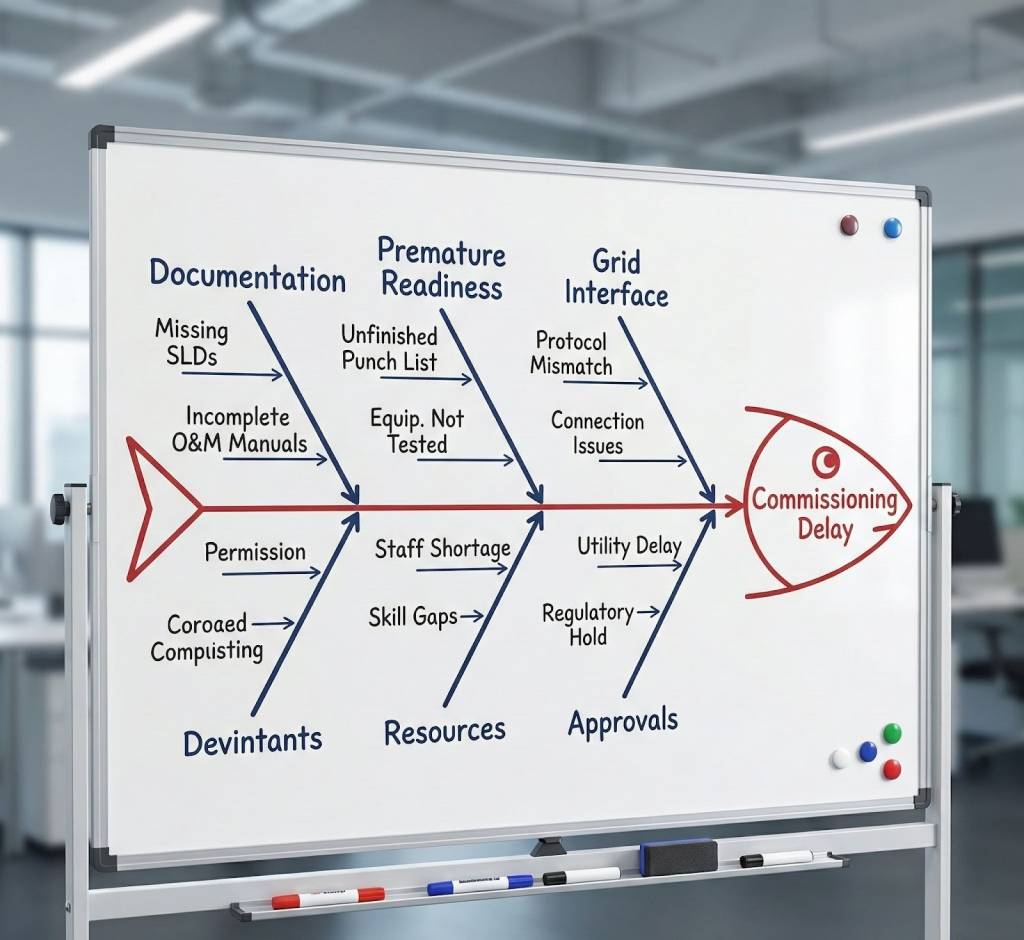
Alt Text for SEO: “Fishbone diagram showing the root causes of electrical commissioning delays in GCC projects.”
The High Stakes of the Final Mile: More Than Just a Schedule Slip
In the GCC construction sector, commissioning is not merely the end of the project; it is the most risk-intensive phase. A delay here does not just mean a schedule slip; it triggers a financial avalanche.
- Liquidated Damages (LDs): Contractors face massive penalties for missing the handover date.
- Idle Resource Burn: Keeping a full commissioning team and specialized vendor engineers on site for an extra month can cost hundreds of thousands of dollars.
- Investor Confidence: For Independent Power Projects (IPPs) or industrial plants, missed revenue dates erode stakeholder trust.
Avoid the financial trap. Explore our Commissioning Management Services and Project Lead Engineering.
Root Cause #1: The “Documentation Black Hole”
You cannot test what you cannot verify. The most common cause of electrical commissioning challenges is the “Documentation Black Hole,” where functional testing grinds to a halt because the paperwork isn’t ready.
- Manifestations: Commissioning engineers arrive to find Single Line Diagrams (SLDs) that are not approved for construction, missing factory test reports, or absent vendor manuals.
- The Fix: Implement a Documentation Readiness Index (DRI). This metric should be tracked from Day 1, linking document approvals directly to construction payment milestones. No document, no payment.
Root Cause #2: Incomplete Pre-Commissioning & Punch List Management
There is often a rush to “show progress” by starting commissioning before construction is truly finished. This is a fatal error.
- Manifestations: Attempting to energize a switchboard while painters are still working in the room, or starting loop checks when cables haven’t been glanded or labeled. This leads to thousands of open punch list items that bury the team in administration.
- The Fix: Enforce a strict Mechanical Completion (MC) or “Ready for Commissioning” (RFC) gate. The commissioning team must refuse to accept any system until its construction punch list is clear or manageable.
Root Cause #3: Grid Connection & Utility Interface Bottlenecks
This is a specific hurdle for project handover delays Saudi Arabia and the wider GCC. The utility provider (SEC, DEWA, ADDC, etc.) is the ultimate gatekeeper, and their internal processes are often outside the EPC’s direct control.
- Manifestations: Delays in securing final revenue meters, waiting months for protection relay coordination studies to be approved, or inability to schedule a utility witness for the final grid connection test.
- The Fix: Appoint a dedicated Utility Interface Manager from the project’s inception. Do not wait until the end; engage the utility in design reviews early and often to prevent last-minute surprises.
Root Cause #4: Unqualified Resources & Poor Test Execution
Commissioning requires a fundamentally different mindset and skillset than construction. Using construction supervisors to lead commissioning is a recipe for chaos.
- Manifestations: Technicians who can install wiring but cannot troubleshoot a logic fault, lack of certified test equipment, or expired calibration certificates for critical instruments.
- The Fix: Develop a Commissioning Resource Plan upfront. Budget for and secure vendor-certified specialists for complex systems (e.g., HV GIS, BMS, DCS) well in advance.
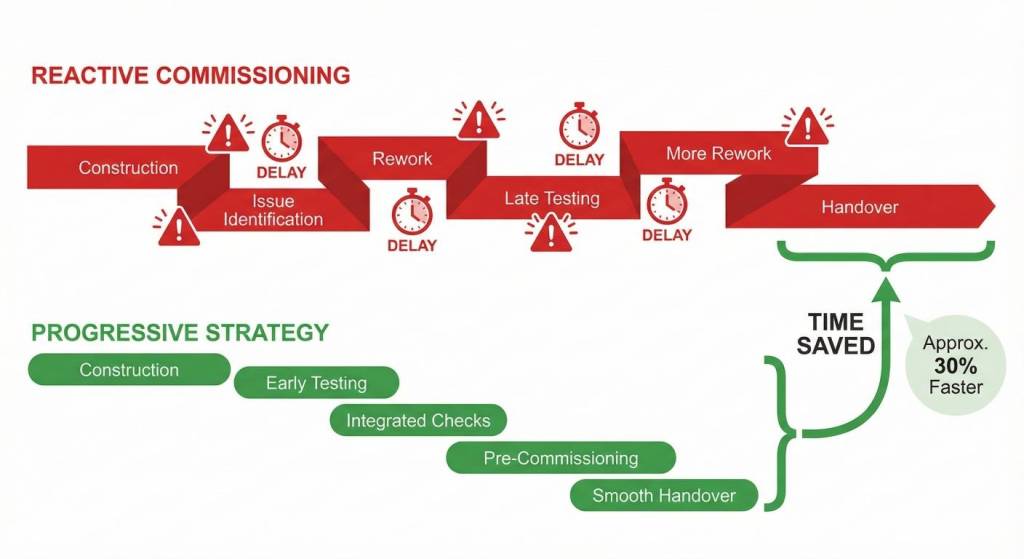
Alt Text for SEO: “Gantt chart comparing reactive versus progressive commissioning strategies to avoid delays.”
Root Cause #5: The “Big Bang” vs. Progressive Commissioning Mindset
The traditional “Big Bang” approach—waiting for the entire facility to be built before testing anything—is obsolete and dangerous.
- Manifestations: A mad rush in the final weeks where problems in one system (e.g., HVAC) cascade into others (e.g., Switchgear room cooling), making isolation and diagnosis impossible.
- The Fix: Advocate for Progressive Commissioning. Test and energize systems as they become ready. For example, commission the main substation and lighting before the production line is finished. This spreads the workload and identifies issues early.
The Proactive Blueprint: Implementing a Delay-Proof Commissioning Strategy
How to avoid project delays UAE and GCC-wide? It requires a strategic shift.
1. Develop a Master Commissioning Plan (MCP) During Design
The MCP is not a document to write a month before handover. It must be developed during the design phase to define the testing philosophy, system boundaries, schedule logic, and resource requirements.
2. Establish a Centralized Commissioning Management Office (CxMO)
Create a dedicated, empowered team that owns the process from RFC to COD. This team cuts across all subcontractors and reports directly to the Project Director, ensuring unbiased reporting.
3. Leverage Digital Completions Management Systems
Move away from spreadsheets. Use cloud-based digital platforms to track punch lists, test records, and certificates in real-time. This ensures transparency and speeds up the handover certification process.
Frequently Asked Questions (FAQs)
Q1: Who is typically responsible for commissioning delays?
Responsibility is shared but often falls on the EPC Contractor for execution readiness and the Project Owner for ensuring adequate oversight and utility engagement. The root is usually a management failure to prioritize commissioning as a distinct, resourced phase.
Q2: Can better contracts help prevent this?
Absolutely. Contracts must clearly separate Construction and Commissioning milestones, with distinct payment triggers. They should define readiness criteria (like the definition of Mechanical Completion) and include incentives for early completion of commissioning activities.
Q3: What is the single most effective action we can take?
Appointing an independent Owner’s Commissioning Agent early in the project. This entity acts as the owner’s expert, developing the MCP, auditing contractor readiness, and witnessing all tests to ensure no corners are cut.
Q4: Are some project types more prone to these delays?
Yes. Projects with novel technology (e.g., first-of-a-kind BESS), high grid interconnection complexity, or fast-track schedules are at greatest risk. These require even more rigorous front-end planning.
Conclusion
Commissioning delays are not an inevitability; they are a consequence of poor early strategy. The solution is to treat commissioning not as a checklist at the end, but as a core project discipline from the very beginning.
Don’t allow your project’s success to be undermined in the final phase. Our commissioning management and owner’s engineering services provide the expert oversight, rigorous planning, and proactive utility coordination needed to navigate GCC projects to a smooth, on-time energization.
Contact us to review your project’s commissioning readiness and secure your timeline.