

In the lifecycle of any major construction project in the Gulf, whether a Giga-project in NEOM or a high-rise in Dubai Marina, there is a familiar and frustrating phase known as “The 95% Trap.” Construction is mechanically complete, cables are pulled, and panels are energized. Yet, the project sits in a state of suspended animation for months, bleeding budget on overheads while awaiting final handover.
The culprit? Commissioning.
Industry data from major GCC infrastructure projects reveals that the Electrical Construction & Commissioning Management phase consumes 15-25% of the total project timeline. The bottleneck is rarely the testing itself, but the witnessing of tests. With thousands of electrical assets, from individual light fixtures to complex MV switchgear, the traditional expectation that the Client, Consultant, and Third-Party Agent must physically witness 100% of all tests is mathematically impossible within a standard schedule.
Trying to inspect every socket outlet in a 50-story tower creates a logistical logjam that guarantees delays. The solution lies in shifting from a “Brute Force” approach to Strategic Sampling. By applying witness test planning methodologies grounded in statistical risk analysis, project directors can accelerate commissioning schedules by up to 30% while maintaining rigorous quality standards.
The GCC Commissioning Challenge: Multiple Stakeholders and Regulatory Bodies
Commissioning in the GCC is not a bilateral agreement between builder and owner; it is a multi-stakeholder ecosystem with rigid bureaucratic requirements.
The “Signature Chase”
On a typical day in Riyadh or Doha, a single energization test might require signatures from:
- The MEP Contractor: Performing the test.
- The Main Contractor: Verifying the prerequisite works.
- The Supervision Consultant: Protecting the client’s interest.
- The Client Rep: Ensuring operational readiness.
- The Third-Party Commissioning Agent (CxA): Validating LEED/Estidama compliance.
- The Utility (DEWA/SEC/Kahramaa): For grid connection points.
- Civil Defense: For life safety interfaces.
The Calendar Constraints
GCC commissioning coordination faces unique scheduling hurdles:
- Ramadan: Working hours are reduced, often compressing the witnessing window to 4-5 effective hours per day.
- Summer Work Bans: Midday breaks prevent outdoor testing of transformers or solar arrays during peak sun hours.
- Geographic Dispersion: In sprawling projects like the Red Sea or Al Ula, just getting the consultant to the specific asset can take an hour of travel time.
If the Witness Test Plan (WTP) requires all these stakeholders to be present for every minor test, the schedule will inevitably slip. Robust Project Lead Engineering & Management is essential to navigate these constraints and enforce a streamlined protocol.
Risk-Based Sampling Methodology: The Statistical Approach to Test Planning
To break the deadlock, we must treat quality assurance as a statistical science, not a clerical exercise. This involves adopting risk-based sampling methodologies, similar to those used in high-volume manufacturing (like ISO 2859-1 or MIL-STD-105E).
The Core Concept: Verify the Process, Not Just the Product
The goal of witnessing is to verify that the contractor has a robust Quality Control (QC) process.
- Contractor Testing (100%): The contractor must physically test 100% of the equipment and submit passed reports.
- Witnessing (Sample %): The consultant witnesses a random sample to verify the accuracy of the contractor’s reports.
The Logic of AQL (Acceptable Quality Level)
If you witness 10% of the light fixtures (Sample Size) and find zero defects, statistically, the remaining 90% are highly likely to be acceptable. If you find a failure rate >1%, the sample size automatically escalates to 25% or 100%. This dynamic statistical test planning incentivizes the contractor to pre-test rigorously.
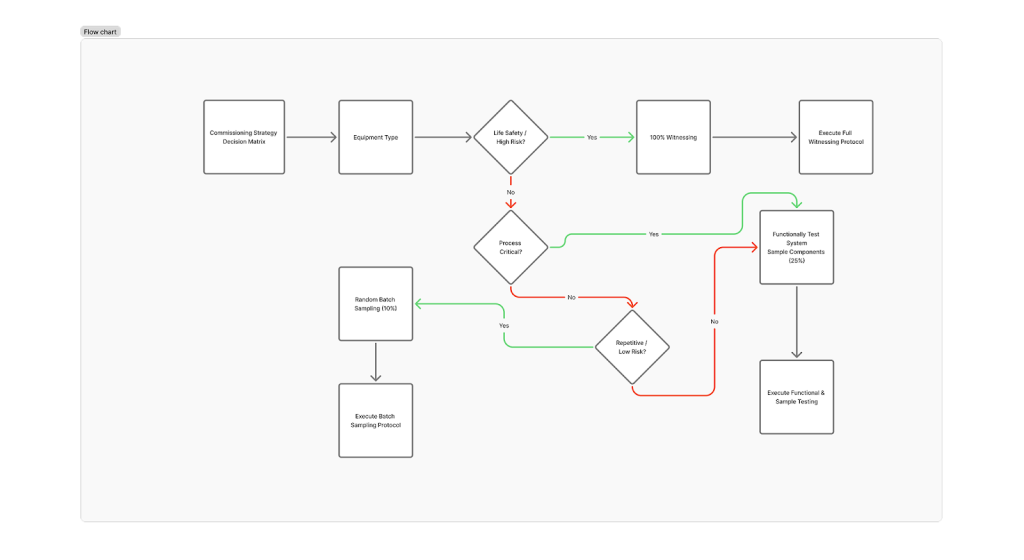
Category 1: Safety-Critical Systems – 100% Testing Requirements
Strategic sampling has a hard limit: Life Safety. There is zero tolerance for risk when human lives are at stake.
The Non-Negotiables
For these systems, 100% testing requirements apply to witnessing. Every sensor, every interface, and every trigger must be viewed by the Engineer and often the Civil Defense authority.
- Fire Alarm Systems: Every smoke detector and call point must be tested.
- Emergency Lighting: A full discharge test for every centralized battery and standalone fitting.
- Earth Leakage Protection: Every RCD/RCBO protecting wet areas or accessible sockets.
- Earthing & Lightning Protection: Every earth pit resistance measurement.
Regulatory Compliance
In the UAE, the Civil Defense code (UAE Fire and Life Safety Code of Practice) mandates rigorous witnessing. Attempting to sample these systems will lead to failed final inspections and a rejection of the Building Completion Certificate (BCC).
Category 2: Performance-Critical Systems – Stratified Sampling Approach
Here, we move from “Safety” to “Functionality.” For complex systems like BMS, HVAC controls, or Industrial Automation, testing every single input/output (I/O) point with a witness is inefficient.
The System-Level Focus
Instead of witnessing every sensor, focus on performance system commissioning at the loop level.
- Stratified Sampling:
- Scenario: A building has 50 Air Handling Units (AHUs).
- Strategy: Witness the full “Sequence of Operation” (Startup, Shutdown, Fire Alarm Interlock, Valve Modulation) on a sample of 5 AHUs (10%).
- Validation: Review the contractor’s test sheets for the remaining 45. Check the BMS graphics for all 50 to ensure they are reading correctly.
- Focus on Interfaces: Spend the time witnessing the complex interfaces (e.g., Generator to Switchboard synchronization) rather than simple component status.
Category 3: Repetitive Standard Equipment – Batch Testing Protocols
This is where the biggest schedule gains are found. A large project might have 20,000 light fixtures, 5,000 socket outlets, and 500 small fan coil motors.
The Batch Testing Protocol
Instead of booking inspections for “Floor 1 Sockets,” then “Floor 2 Sockets,” utilize batch testing electrical protocols.
- Define the Lot: e.g., “All 500 socket outlets in Tower A, Floors 1-10.”
- Contractor Pre-Test: Contractor tests all 500 and submits a consolidated report confirming polarity and earth loop impedance.
- Witness Sample: The consultant walks the floor and points to 50 random sockets (10%) for re-testing on the spot.
- Pass/Fail:
- 0 Failures: The entire batch of 500 is signed off.
- 1+ Failures: The consultant rejects the entire batch. The contractor must re-check all 500 and call for inspection again (at their own cost).
This method drastically reduces the “inspection churn” that clogs up repetitive equipment commissioning.
Technology Integration: Digital Witnessing and Remote Approval Systems
The post-pandemic era has accelerated the acceptance of remote technology in construction.
The Virtual Inspector
For projects in remote areas (e.g., desert solar parks or offshore islands), travel time kills productivity. Digital witnessing systems bridge the gap.
- Live Streaming: Using intrinsically safe smart glasses (e.g., RealWear) or simply MS Teams on a tablet, the site engineer livestreams the test to the Consultant and Client sitting in the HQ office.
- Data Validity: The camera zooms in on the multimeter reading or the HMI screen to verify the result.
- Cybersecurity: Secure, encrypted platforms (like Aconex or specialized commissioning software) are used to host the session and record the evidence, ensuring remote commissioning approval is auditable.
The Witness Test Plan (WTP) Document: Structure and Approval Process
The strategy fails if it isn’t agreed upon before testing starts. The Witness Test Plan template is the governing constitution of the commissioning phase.
Key Sections of the WTP
- Master Equipment List: Categorized by Criticality (Safety, Performance, Repetitive).
- Sampling Ratios: Explicitly stating “Fire Alarm = 100%”, “Lighting = 10%”.
- Notification Times: How much notice is required (e.g., 24 hours vs. 48 hours).
- Failure Protocols: What triggers a batch rejection?
- Sign-Off Flow: Who has the ultimate authority to close a test?
Strategic Tip: Get the WTP approved by the Client and Consultant during the construction phase (months before power-on). Trying to negotiate sampling rates during commissioning is a recipe for conflict.
Case Study: Mega-Project in Saudi Arabia – 45-Day Schedule Savings
To illustrate the impact, consider a recent commissioning case study KSA for a mixed-use development in Riyadh involving 12 towers.
The Original Plan
- Approach: 100% witness testing of all electrical devices.
- Estimated Duration: 6 months.
- Bottleneck: Only 2 consultant engineers were available to witness 40,000+ points.
The Optimized Plan
- Strategy: Implemented “Batch Testing” for lighting/power (10% sample) and “Digital Witnessing” for remote utility buildings.
- Safety: Retained 100% witnessing for Fire/Life Safety.
- Result: The witnessing workload was reduced by 65%.
- Outcome: Commissioning was completed in 4.5 months (a 45-day saving), allowing the client to hand over the residential units ahead of the penalty deadline.

Implementation Toolkit: Templates, Checklists, and Software Recommendations
How do you roll this out?
Templates and Checklists
Standardize your “Request for Inspection” (RFI) forms. They should clearly state:
- “This is a Batch Inspection.”
- “Total Quantity: 200.”
- “Sample Quantity to Witness: 20.”
- “Random Selection by: Consultant.”
Software Tools
Move away from paper. Use commissioning implementation toolkit software like:
- CxAlloy or BIM 360 Build: For tracking assets, linking checklists to barcodes, and managing issue logs.
- PowerBI: To visualize progress. “Percent Complete” is vague; “Percent Witnessed vs. Planned” is actionable.
Frequently Asked Questions (FAQ)
1. Will the Civil Defense or Utility Authority accept sampling?
Generally, no. Authorities like Civil Defense, DEWA, or SEC usually require 100% witnessing of the specific systems they govern (Fire, Grid Connection). The sampling strategy applies primarily to the inspections done by the Consultant and Client, which constitute the bulk of the volume.
2. What happens if a random sample fails?
The protocol must be strict. If a sample fails, the entire batch is rejected. The contractor must re-test 100% of the batch internally and submit a rectification report before a new witnessing appointment is granted. This puts the burden of quality back on the installer.
3. Does sampling increase the risk of latent defects?
There is a minor statistical risk, but it is outweighed by the risk of “inspection fatigue.” When consultants are forced to watch 10,000 identical tests, they lose focus and miss things. Inspecting 10% with high rigor often yields better quality than inspecting 100% with low energy.
4. Can we use sampling for High Voltage (HV) equipment?
No. HV equipment (Transformers, RMUs, Switchgear) is too critical and low-volume. Every piece of HV equipment should be 100% witnessed, often including the Factory Acceptance Test (FAT).
5. How do we convince a conservative consultant to agree to sampling?
Demonstrate the QC process. If the contractor can show a robust internal Quality Assurance system with digitized records of their own 100% testing, consultants are more likely to trust the sampling approach. The WTP document is your negotiation tool.
Conclusion: Speed Through Strategy, Not Shortcuts
Accelerating commissioning is not about cutting corners; it is about cutting waste. The hundreds of hours spent watching repetitive, low-risk tests are hours taken away from verifying the complex, high-risk safety systems that actually matter.
By adopting a Witness Test Plan based on strategic sampling, digital integration, and risk logic, GCC project managers can break the “95% Trap.” You deliver a safe, compliant, and operational building to the client faster, turning the commissioning phase from a bottleneck into a competitive advantage.
Struggling with a stalled commissioning schedule?
Effective commissioning requires engineering leadership. Elecwatts is a specialized electrical engineering consultancy that helps contractors and clients draft robust Witness Test Plans, negotiate sampling protocols with consultants, and deploy digital witnessing tools to drive projects to the finish line.
Contact Elecwatts today to optimize your commissioning strategy.